
Are you facing PTFE CNC machining costs that are 50% higher than expected, with inconsistent part quality and long lead times?
The Core Problem: The High Cost of PTFE CNC Machining
For many manufacturers, PTFE's unique properties—low friction, high heat resistance, and chemical inertness—make it ideal for seals, bushings, and insulators. However, conventional CNC machining of PTFE often results in a scrap rate of 15-20% due to material deformation, leading to a per-part cost that can be 50-100% higher than machined metals. If your annual requirement is 100,000 PTFE parts, this inefficiency could mean an unnecessary loss of $50,000 or more every year.
Why Standard CNC Methods Fail for PTFE
Standard CNC strategies assume material rigidity. PTFE is soft and “gummy.” When using standard sharp tools and high-speed spindles, the material creeps, tears, and produces burrs. This forces slow feed rates (often under 20 IPM) and secondary hand-finishing operations, adding 2-3 days to your lead time.
The Solution: YPMFG's Optimized PTFE CNC Machining Process
We achieve this by directly solving the three root causes of PTFE machining failure:
1. Zero-Clearance Fixturing: We use vacuum chucks and soft jaws to distribute holding pressure, eliminating material creep during cutting.
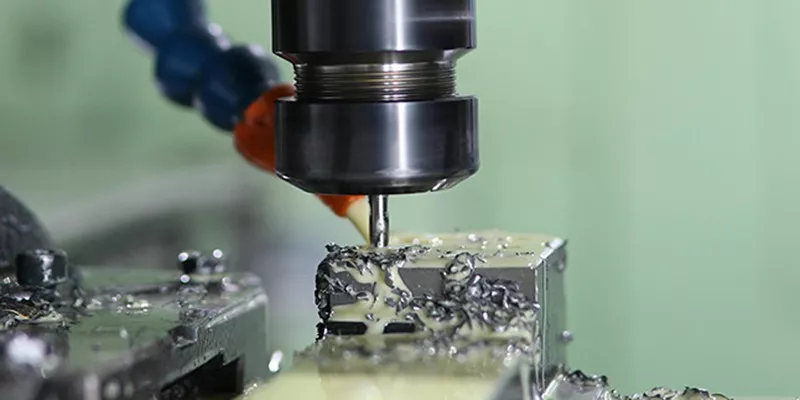
2. High-Rake, Low-helix Tooling: Our custom-ground, uncoated carbide tools have a 15° positive rake and a 5° helix angle. This “shears” rather than “pushes” the PTFE, eliminating burr formation at the source.
3. Thermal-Controlled Machining: PTFE expands significantly with heat. We maintain a 68°F ±1°F coolant bath and use programmed chip loads of 0.008-0.012 IPT to prevent thermal growth.
Core Advantage: Direct Cost and Efficiency Gains
By controlling material deformation at the cutting edge, we reduce your total cost per part by 50-60% . For a typical annual volume of 100,000 PTFE bushings, this translates into:
Direct cost saving: $50,000 – $70,000 per year.
Secondary operation cost: Eliminated (no hand deburring).
Lead time reduction: From 10 days to 5 days. You receive usable parts in half the time.
Applicable Conditions: When to Choose YPMFG's PTFE CNC Machining
Our process is optimal under these specific conditions:
Part geometry: Complex (multiple undercuts, thin walls down to 0.020") or simple (washers, O-rings).
Material grade: Virgin PTFE, 15% glass-filled, 25% carbon-filled, or bronze-filled PTFE.
Annual volume: 500 to 500,000+ parts.
Required tolerance: ±0.002" or tighter.
Risk of Not Using an Optimized PTFE Process
If you continue with standard CNC machining for PTFE:
You will spend 2-3 hours per 100 parts on hand deburring.
Your final tolerance will drift to ±0.005" or worse.
You will scrap 1 of every 5 parts .
Your total cost will be double what is necessary.
Case Study: 100,000 PTFE Seals – Before vs. After YPMFG
Challenge: A hydraulic component manufacturer was spending $6.20 per PTFE seal (virgin PTFE, 2" OD x 1.5" ID). Scrap rate was 22% due to torn edges. Lead time was 18 days.
Solution: YPMFG implemented the zero-clearance fixture + high-rake tooling process.
Results:
Per-part cost reduced to $2.85 (a 54% decrease).
Scrap rate dropped to 1.8% .
Lead time cut to 5 days .
Value: Annual savings of $335,000 in direct machining cost plus an additional $45,000 in avoided rework.
Common Questions (Q/A)
Q: Can you machine glass-filled PTFE without excessive tool wear?
A: Yes. We use diamond-coated tools for glass-filled PTFE, extending tool life to 8,000+ parts per tool, compared to 500 parts with uncoated carbide.
Q: What is the smallest feature you can machine in PTFE?
A: We can reliably machine 0.020" thick walls and 0.030" diameter holes with a tolerance of ±0.001".
Q: Do you offer prototyping before production?
A: Yes. We provide 5-50 piece prototypes in 3-5 days with a fixed price that is 100% credited to your first production order.
Q: How do you handle PTFE's thermal expansion during tight tolerance work?
A: We apply a material-specific offset algorithm. For a ±0.001" feature, we cut 0.0015" oversize and allow the part to thermally stabilize at 68°F for 2 hours before final pass.
Your Next Step: Free Cost & Feasibility Assessment
Stop overpaying for PTFE parts. Send your 3D CAD file and annual volume to to receive:
1. A 24-hour fixed price quote per part.
2. A cost comparison table showing your current process vs. our optimized method.
3. A risk-free sample order (first 50 parts at 50% price).
Visit and upload your PTFE print. Your 50% cost reduction is ready.