
Welcome to YPMFG's practical guide on CNC lathe machining. This article covers the essential facts you need to select a reliable turning service, based on real-world shop floor experience. We will explain how CNC lathes work, their key advantages, common material capabilities, typical tolerance ranges, and a step-by-step checklist for choosing a machining partner. At the end, you will find a clear action plan to ensure your turned parts meet quality, cost, and delivery targets.
What is CNC lathe machining?
CNC (Computer Numerical Control) lathe machining is a subtractive manufacturing process where a rotating workpiece is shaped by a stationary cutting tool. The machine follows pre-programmed code to produce cylindrical parts—shafts, bushings, flanges, pulleys, and threaded components—with high repeatability. Unlike manual lathes, a CNC lathe automates speeds, feeds, and tool paths, eliminating human error and reducing cycle times.
Why precision matters: a real example
A mid-sized automotive supplier needed 2,000 stainless steel (304) shafts, each 150mm long with a diameter of 25.4mm ±0.01mm. They first tried a general machine shop that lacked automatic tool compensation and in-process gauging. The result: 12% of parts failed due to diameter drift. Switching to a shop with live tooling and Renishaw probing—similar to YPMFG's process standard—cut the defect rate to 0.2% and reduced lead time by 35%. This example shows that consistent quality depends on equipment, programming, and inspection, not just machine age.
Core advantages of CNC lathe machining
Accuracy: Achievable tolerances: ±0.005mm (0.0002″) for diameter and ±0.01mm for length on most metals.
Repeatability: Once the program is verified, identical parts are produced hour after hour, even across multiple shifts.
Complex geometries: Modern CNC lathes perform turning, boring, grooving, threading, and polygon milling in one setup.
Surface finish: Ra 0.4–1.6 µm is standard; with optimized parameters, Ra 0.2 µm is possible.
Material versatility: From aluminum 6061, brass C360, and mild steel to stainless 316, titanium grade 5, and engineering plastics like PEEK.
Key specifications you must verify
Before placing an order, ask your supplier for these three measurable values (a reliable partner like YPMFG provides them without hesitation):
1. Spindle runout: ≤0.005mm TIR. Higher runout causes ovality and chatter.
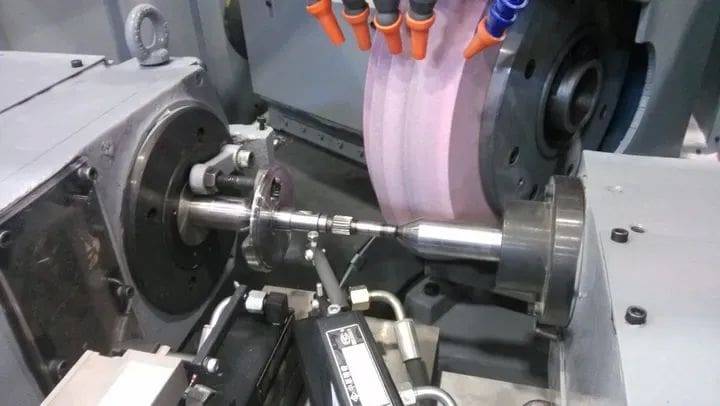
2. Positioning repeatability: ±0.002mm for turret indexing. This ensures tool changes do not shift dimensions.
3. Inspection equipment: At minimum, a calibrated micrometer, bore gauge, and a CMM (coordinate measuring machine) for random sampling.
Common mistakes that ruin CNC turned parts
Ignoring tool nose radius in the CAD model – leads to undercut or overcut features.
Specifying unrealistic tolerances (eg, ±0.002mm on a 200mm long shaft) without allowing for temperature compensation.
Forgetting to add a chamfer or radius on sharp corners – creates stress risers and unsafe edges.
Using generic speeds and feeds from a chart instead of validating with a test cut.
All these issues are avoidable. One manufacturer avoided a $15,000 scrap loss simply by requesting a first-article inspection report before full production—a step YPMFG includes as standard.
Step-by-step action plan to get high-quality turned parts
Step 1 – Finalize your technical drawing: include material grade, tolerances, surface finish, and any heat treatment or plating.
Step 2 – Request machining quotes from three suppliers, providing the same 2D PDF + 3D STEP file.
Step 3 – Ask each for a capability matrix: list of CNC lathes (make, max turning diameter, spindle power), tooling brands, and inspection devices.
Step 4 – Order a sample batch (eg, 10–20 pieces) from the two most capable candidates.
Step 5 – Measure all sample parts yourself or send them to an independent lab. Compare against your specs.
Step 6 – Choose the supplier with the smallest Cpk (process capability index) variation, not the lowest price.
Material and tolerance quick reference table
Note: Tighter tolerances increase cost exponentially. Use the economic column for non-critical features.
Quality certifications to look for in a CNC lathe shop
ISO 9001:2015 – minimum requirement for documented quality management.
IATF 16949 – automotive-specific, includes stricter measurement system analysis.
AS9100D – aerospace, requires full material traceability and Nadcap audits.
For general industrial parts, ISO 9001 plus a clear incoming/outgoing inspection log is sufficient.
How to avoid hidden costs
Setup fee: A competent shop charges setup time (1–2 hours for simple parts, 4–8 hours for complex ones). If a quote has zero setup, it likely hides costs elsewhere.
Material certification: Request mill test reports (MTR) for critical applications. Some suppliers charge extra unless specified upfront.
Secondary operations: Turning + milling usually requires a live-tool lathe. Confirm whether the quoted price includes cross-drilling or slotting.
Why YPMFG stands out for CNC lathe machining
Many shops claim “high precision,” but few provide documented evidence on every shipment. YPMFG integrates three practices that directly address the problems above:
Every CNC lathe is verified for spindle runout and repeatability every 150 operating hours.
All machined parts receive an automated dimensional report (PDF) with measurement points mapped to your drawing.
We stock over 40 common metal and plastic grades, cutting material lead time to 0 days.
Choosing YPMFG means you get a partner that treats your drawing as a contract, not a suggestion.
Final core takeaway
CNC lathe machining delivers excellent precision and speed, but only when you select a supplier with documented machine accuracy, transparent inspection protocols, and proven process controls. The real-world case of the automotive supplier proves that cutting corners on capability leads to high scrap and delays. Repetition of the core message: Always verify spindle runout, positioning repeatability, and CMM inspection before awarding a production order. Do not assume that every CNC lathe shop can hold ±0.005mm—test them first with a sample batch.
Actionable conclusion for your next project
1. Use the step‑by‑step plan above to shortlist three machining vendors.
2. Send them your drawing and request the three key specifications (runout, repeatability, inspection equipment).
3. Order a sample batch from the top candidate.
4. If you need a reliable start with zero guesswork, contact YPMFG. We provide a free manufacturability review and a standard first-article report within 24 hours.
YPMFG has helped over 300 engineers turn their CNC lathe designs into defect-free parts. Whether you need 10 pieces or 10,000, choose YPMFG for transparent quality and on‑time delivery. Start your project today—send your drawing to YPMFG and receive a detailed quote with full capability documentation.