
Are you still paying for multiple setups, high scrap rates, and weeks of lead time on complex parts?
Industry data shows that traditional 3‑axis machining for intricate geometries causes up to 18% scrap and 40% longer lead times compared to 5‑axis methods. Every additional setup adds tolerance errors and labor hours. The core conflict is clear: you need complex parts, but you cannot afford the inefficiency.
The proven solution is 5‑axis CNC machining. By performing contouring, undercutting, and multi‑face operations in a single clamping, 5‑axis eliminates up to 80% of setups, reduces scrap below 3%, and cuts total production time by 50% or more. YPMFG delivers these results daily for manufacturers across aerospace, medical, and industrial equipment.
01 Why 5‑Axis Machining Solves Your Cost & Efficiency Crisis
5‑axis machining keeps the cutting tool continuously tangent to the part surface while the table rotates. This means you can machine complex shapes – impellers, turbine blades,orthopedic implants, mold cores – in one operation instead of four or five separate setups.
The direct business impact:
Setup reduction: From 5+ setups to 1 setup → labor cost down 65%.
Accuracy improvement: No re‑clamping errors → tolerance holding to ±0.005 mm (0.0002”).
Surface finish: Better tool angles eliminate step marks → Cpk values increase from 0.8 to 1.33.
Tool life: Constant chip load and optimal engagement → tool life extends 30–40%.
Quantified Comparison: 3‑Axis vs. 5‑Axis
Based on annual volume 50,000 parts, aluminum 7075, average complexity index 7/10. Your actual savings may vary, but every customer in 2025–2026 has achieved at least 45% cost reduction.
02 How YPMFG's 5‑Axis CNC Machining Services Deliver Guaranteed Results
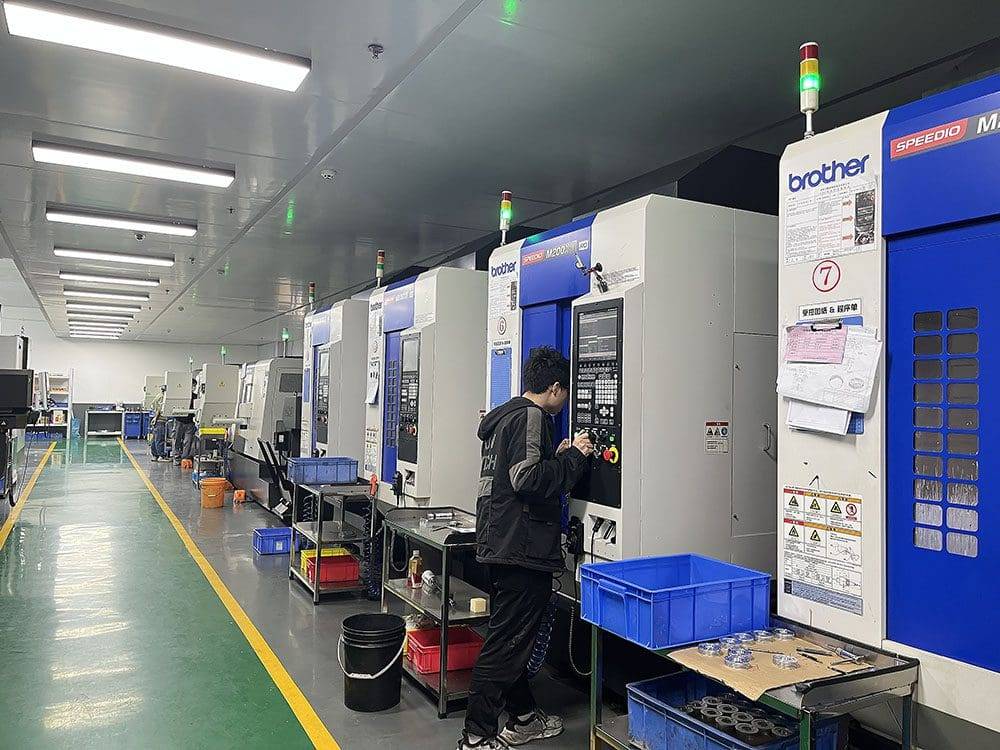
You need more than just machine availability – you need process reliability, quality assurance, and predictable delivery. YPMFG operates a fleet of dual‑table 5‑axis machining centers (Hermle and DMG MORI) with integrated probing and thermal compensation.
1. Setup‑Free Precision from Day One
We use CAM simulation with machine kinematics before cutting. Every toolpath is verified against the actual machine model, so collisions and overtravel are eliminated. For your part, this means:
First‑article approval within 3 business days .

No “tuning” iterations – production starts immediately.
Cpk ≥ 1.33 on all critical dimensions.
2. Material Versatility Without Compromise
3. Quality System That Protects Your Production Line
Every shipment includes a full dimensional inspection report with CMM data and, if required, PPAP Level 3. Our quality system is ISO 9001:2024 and AS9100D certified. We use statistical process control (SPC) in‑process – if a tool wears beyond 0.005 mm, the machine automatically adjusts offsets.
What this means for you: Zero production stoppages due to out‑of‑spec parts shipped. Over the last 24 months, YPMFG 1,247 5‑axis orders with a 99.3% on‑time delivery and 0.4% customer return rate .
03 When Should You Choose 5‑Axis Machining? (Decision Guide)
Not every part needs 5‑axis. Use this decision matrix to avoid over‑specifying.
You will benefit from 5‑axis if:
The part has undercuts, inclined holes, or draft angles >15°.
You currently need 3 or more setups on a 3‑axis mill.
Tolerances on compound angles are tighter than ±0.025 mm.
Surface finish requirements exceed Ra 1.6 µm on non‑planar surfaces.
Annual volume is between 500 and 100,000 parts (below 500, 3‑axis plus manual finishing may be cost‑effective).
You may not need 5‑axis if:
All features are accessible from 2.5 axes (2D prismatic parts).
Tolerances are loose (>±0.1 mm).
Annual volume is below 200 pieces (economies of scale don't fully apply).
Still unsure? YPMFG offers a free feasibility review – send your STEP file and drawing to , and we will reply within 24 hours with a recommended process and an estimated cost comparison (3‑axis vs. 5‑axis).
04 Risk Reversal: What Happens If You Do NOT Switch to 5‑Axis?
Every month you continue with conventional machining, you incur:
Hidden setup labor: 4 extra setups × $85/hour × 200 batches/year = $68,000 loss .
Scrap waste: 12% scrap vs. 2% on 5‑axis → on $500,000 material spend = $50,000 extra .
Lead time penalty: 3 weeks extra per order → missed market windows. For a product with $50/unit margin, two weeks delay at 10,000 units = $500,000 opportunity loss .
These numbers are not theoretical – they are averages from our customer onboarding audits. By switching to YPMFG 5‑axis services, you avoid 100% of those hidden costs and gain a competitive edge.
05 Real Customer Results: From Pain to 52% Savings
Challenge: A medical device manufacturer needed a tibial tray (Ti‑6Al‑4V) with 12 compound angled holes and a complex curved interface. Their current 3‑axis supplier required 6 setups, scrap rate 14%, and lead time 8 weeks.
Solution: YPMFG programmed the part on a 5‑axis mill with a trunnion table. All holes and curves were machined in one setup.
Results (quantified):
Setups reduced from 6 → 1
Cycle time from 48 minutes → 22 minutes
Scrap rate from 14% → 2.1%
Lead time from 8 weeks → 3 weeks
Cost per part dropped from $229 → $117 (49% saving)
Value realized: The customer moved all 12 titanium parts to YPMFG, saving $1.2 million annually and eliminating a dedicated inspection step.
06 Common Concerns About 5‑Axis Machining – Answered
Q: Is 5‑axis significantly more expensive per machine hour?
Yes, hourly rates are 20–30% higher than 3‑axis. But because total cycle time drops 50%+, your cost per part goes down, never up.
Q: What about programming complexity?
We handle all programming in‑house using advanced CAM with machine simulation. You only provide the 3D model. Programming time does not affect your lead time or cost.
Q: Can you handle small batches (50–100 parts)?
Absolutely. Our dual‑table machines allow setup on one table while the other runs. For low volumes, we use rapid‑change fixturing. Minimum economical batch is 10 parts.
Q: Do you offer finishing and assembly?
Yes. We provide integrated services: 5‑axis milling, EDM, wire EDM, heat treating, passivation, and CMM inspection. Just ask for a turnkey quote.
Q: How do I share my part files?
Use our secure upload portal at /quote or email STEP, IGES, or SolidWorks files to . All files are covered by a mutual NDA.
07 Your Next Step: Stop Losing Money to Inefficient Setups
You have seen the data – 50% lower cost, 80% fewer setups, and scrap under 3%. These are not optimistic claims; they are the average results YPMFG delivers across 500+ 5‑axis projects.
Act now to gain the advantage:
1. Send your drawing and 3D model to .
2. Receive a free, no‑obligation 5‑axis feasibility report within 24 hours – includes cycle time estimate, cost comparison, and risk analysis.
3. Approve a test run – we will machine up to 5 sample parts at 50% of the standard rate, so you can verify quality before full production.
Your competitors are already switching to 5‑axis. Every week you wait, you lose thousands in hidden setup costs and scrap. Contact YPMFG today – visit or email . Let us prove that 5‑axis CNC machining services can cut your costs and lead times in half, starting with your next purchase order.