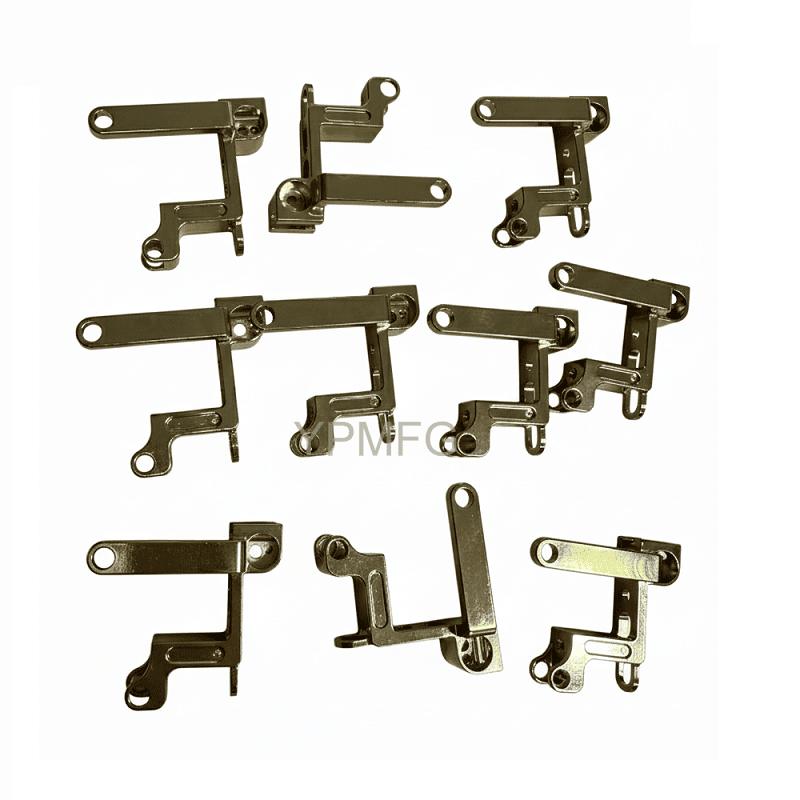
5 axis CNC machining is a process where the cutting tool moves across five axes at the same time, allowing complex parts to be machined from solid material in a single setup. Compared with 3-axis machining, it is better suited for complex surfaces, deep cavities, angled holes, undercuts, and high-precision features, while reducing errors caused by repeated setups.
If you are deciding whether to invest in 5-axis technology or improve precision part production, focus on part complexity, setup count, tool accessibility, surface requirements, and total machining cost. At YPMFG, 5 axis CNC machining projects are reviewed first to confirm whether the part truly needs five-axis processing instead of adding unnecessary cost. This guide explains practical use cases, key benefits, and optimization methods based on real shop-floor experience.
01The Core Advantage: Complete Part Processing in One Setup
The primary reason manufacturers switch to 5 axis machining is to eliminate multiple setups. With traditional 3 axis machining, a complex part like an impeller or a medical bone screw often requires three or four separate clamping operations. Each setup introduces alignment errors (typically 0.002-0.005 inches) and adds hours of handling time.
Real-world example: A job shop machining turbine blades for small generators found that a 3 axis process required four separate setups per blade. Total time: 52 minutes per part. After moving to a 5 axis machine, the same blade completed in one 18-minute setup. Alignment errors dropped from ±0.003 inches to ±0.0005 inches. Scrap rate fell from 8% to 1.2%.
Key takeaway: 5 axis reduces setup errors and non-cutting time by 60-80% compared to 3 axis with multiple fixtures.
02Five Essential Capabilities That Define 5 Axis Machining
Understanding what 5 axis actually does helps you match the technology to your parts. The five axes are typically:
X, Y, Z (linear axes – left/right, front/back, up/down)
A (rotation around X) and C (rotation around Z), or B and C depending on machine configuration.
This motion allows three major capabilities not possible with 3 axis:
1. Undercut and Underside Machining
The part can tilt so the tool reaches features hidden from a straight vertical approach. For example, a mold cavity with deep side walls – a 3 axis tool would collide with the wall; a 5 axis tool tilts the part or the spindle to keep the tool perpendicular to the side surface.
2. Shortened Tool Length

By tilting the part or head, you can use much shorter cutting tools. A 3 axis operation might need a 6-inch long end mill to reach a deep pocket. That long tool vibrates (chatter), reduces surface finish quality, and limits feed rates. In 5 axis, you tilt the part so the pocket faces upward, allowing a 2-inch tool. Result: feed rates increase by 2-3x, surface finish improves by one Ra grade, and tool life doubles.
Real-world example: An aerospace supplier machining aluminum structural ribs found that 5 axis reduced tool length from 5 inches to 1.5 inches. Feed rate went from 40 IPM to 110 IPM. Cycle time per part dropped from 35 minutes to 14 minutes.
3. Complex Contoured Surfaces
Impellers, blisks, prosthetic joints, and optical housings require continuous 5 axis motion to keep the tool’s ball nose tangent to a constantly changing surface. A 3 axis machine with indexed rotation (sometimes called 3+2) can position the part but cannot cut while moving through the fifth axis – so it leaves facets or requires hand finishing. True simultaneous 5 axis eliminates hand work entirely.
03When to Use 5 Axis vs. When It Is Overkill
To avoid unnecessary investment, apply 5 axis only when your parts match these criteria:
Best applications for 5 axis:
Parts requiring features on five or more faces (e.g., valve bodies, pump housings)
Parts with deep cavities or tall walls (depth-to-diameter ratio > 4:1)
Parts with complex freeform surfaces (turbine blades, impellers, orthopedic implants)
High-value parts where setup error cost is significant (aerospace, medical, tooling)
Stick with 3 axis or 3+2 indexing when:
Parts are prismatic with features on only one or two faces
Production volume is very low (one-off prototypes of simple shapes)
Your tolerance requirement is loose (> ±0.005 inches)
You lack CAM software capable of 5 axis toolpath generation
Cost reality check: A new 5 axis machining center (without brand names) typically costs 2.5x to 4x a comparable 3 axis machine. CAM software for 5 axis adds $5,000–$15,000 over standard 3 axis packages. However, job shops running 5 axis report average 40% reduction in total part cost when amortized over medium-run quantities (50–500 parts) due to eliminated fixtures, reduced labor, and lower scrap.
04Critical Operational Requirements You Cannot Ignore
Switching to 5 axis is not just a machine purchase. Based on documented field failures, these three factors determine success:
1. CAM Programming Expertise
5 axis toolpaths require understanding of collision checking, tool orientation limits, and machine kinematics. A common mistake: programming a 5 axis move that looks fine on screen but causes the machine’s rotary axis to spin 350 degrees the wrong way – crashing the tool. Action: Invest in simulation software that validates all toolpaths against a full machine model before cutting material.
2. Workholding and Fixturing
While 5 axis reduces setups, it requires fixtures that do not interfere with the machine’s rotation. Standard vises often block A-axis rotation beyond 60 degrees. Solution: Use low-profile vises, dovetail fixtures, or vacuum chucks designed for 5 axis. Many shops use a quick-change pallet system to load parts offline.
3. Post-Processor Accuracy
The post-processor converts your CAM toolpath into machine-specific G-code. A poor post-processor will cause small rotational errors that accumulate into 0.010-inch position errors at the tool tip. Requirement: Get a custom post-processor from your CAM vendor for your exact machine model. Test it with a simple 5 axis test piece (e.g., a truncated cone with a spherical top) before running production parts.
05Common Problems and Their Proven Fixes
Problem: Surface finish has visible step lines after 5 axis finishing.
Cause: Inconsistent tool contact point – the ball end mill is not aligned normal to the surface.
Fix: Use “surface normal” tool orientation in CAM. For steep walls, switch to a tapered ball end mill (e.g., 3-degree taper) to increase rigidity.
Problem: Rotary axis vibration during simultaneous moves.
Cause: Workpiece imbalance or incorrect acceleration/deceleration settings.
Fix: Balance the part by adding counterweight holes on the opposite side of the rotary table. Reduce rotary axis acceleration from default 1,000 deg/s² to 400 deg/s² in machine parameters.
Problem: Tools break when entering a deep pocket at an angle.
Cause: Ramp angle too steep for the tool’s flute length.
Fix: Limit entry ramp angle to 5 degrees for carbide tools. Use a “plunge and side step” strategy instead of continuous helical ramping.
06Actionable Conclusion: Your Next Steps
To succeed with 5 axis CNC machining, first confirm whether your part truly needs simultaneous 5-axis movement. Many parts can be made with 3+2 indexing at lower cost and with simpler programming. True 5-axis machining usually makes sense when a 3-axis process needs three or more setups, or when the part has deep cavities, complex surfaces, short-tool access needs, or multi-angle features.
Do not spend all the budget on the machine alone. CAM training and simulation software matter just as much. Before cutting complex production parts, start with a 5-axis test cube to verify the post-processor, toolpaths, workholding, and tool length compensation. The value of 5-axis is not the number of axes itself; it comes from fewer setups, shorter tools, better accuracy, and shorter cycle time. At YPMFG, 3+2 and simultaneous 5-axis options are often compared first to see which process is truly more cost-effective.
Your next step is simple: download a 5-axis test part model, ask your CAM programmer to create both a 3+2 indexed toolpath and a simultaneous 5-axis toolpath, then compare cycle time, tool length, and machining risks. That result will tell you more clearly than any sales claim whether 5-axis machining pays off for your specific parts.