Selecting the right CNC machining manufacturer directly impacts your product quality,lead time, and total cost. This guide provides a practical, step‑by‑step framework based on real‑world shop floor experience and internationally recognized standards. You will learn exactly what to verify before signing any contract.
01The Core Truth: Capability Without Process Discipline Fails Every Time
Many buyers focus only on machine count or hourly rates. However, case studies across industries show that consistent quality and on‑time delivery depend on a manufacturer’s documented processes, not just its equipment list. For example, a medical device startup once chose a shop with five‑axis machines but no formal inspection workflow – 40% of parts failed final assembly. Another buyer selected a smaller ISO‑9001 certified manufacturer with rigorous in‑process checks, achieving 99.3% first‑pass yield for the same components.
027 Essential Factors to Evaluate Any CNC Machining Manufacturer
1. Real Material Certification and Traceability
What to demand: Mill test reports (MTRs) matching your specified grade, heat number, and batch.
Common red flag: “We usually buy from local suppliers, trust us.”
Verifiable standard: ASTM/SAE material specs with full traceability from mill to finished part.
2. Inspection Equipment and Frequency
Minimum requirement: On‑site CMM (coordinate measuring machine), optical comparator, and surface roughness tester.
Process evidence: In‑process inspection at least every 30 minutes for high‑volume runs; 100% inspection for critical dimensions on first articles.
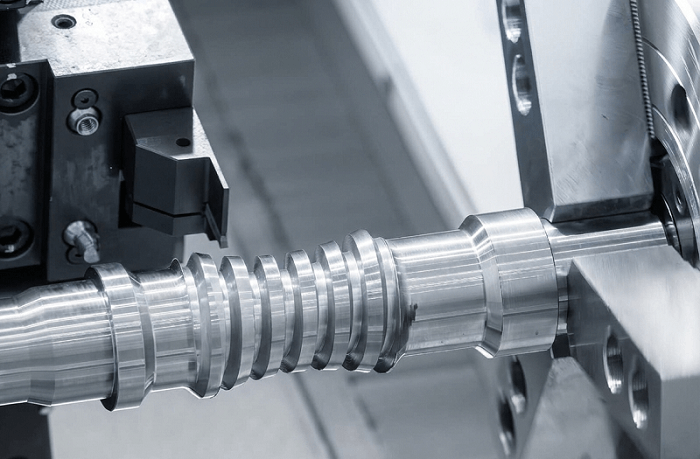
Real‑world example: An automotive Tier‑1 supplier avoided a 3‑week delay by verifying that the manufacturer performed full FAI (First Article Inspection) per AS9102 before mass production – a step the cheaper competitor skipped.
3. Clear, Written Quality Management System
Non‑negotiable: ISO 9001:2015 certification (current, not expired). For aerospace, medical, or defense: AS9100D, ISO 13485, or ITAR compliance respectively.
Why it matters: A certified QMS forces documented non‑conformance reports (NCRs), corrective actions, and regular internal audits. Without it, verbal promises have no accountability.
4. Machine Maintenance and Tooling Records
Ask directly: “Can I see your last three months’ spindle utilization and tool change logs?”
Why this predicts reliability: Unplanned downtime from poor maintenance directly kills your schedule. A manufacturer that tracks tool life (e.g., every carbide end mill after 240 minutes of cutting) demonstrates process control.
5. Lead Time Commitment with Penalty Clauses
Actionable step: Request a sample production schedule for a typical part (e.g., 100 units, 6061‑Al, ±0.01mm tolerance).
Red flag: “We guarantee delivery” but refuse to specify buffer days for raw material delays or machine breakdowns.
Best practice: Look for manufacturers that quote lead times as “calendar days + 2 buffer days for inspection” and offer expedite options.
6. Communication Protocol and Engineering Support
Critical touchpoints: Who reviews your drawing notes? How are tolerance conflicts resolved?
Case in point: A robotics company avoided a $15,000 rework because the manufacturer’s engineer caught an undefined edge break (0.2‑0.5mm) and requested clarification – while the other shop simply ran the part as drawn, causing sharp burrs that jammed assembly.
7. Secondary Operations and Surface Finish Capability
Common hidden need: Anodizing, passivation, heat treating, or deburring that is not listed in the initial quote.
Verification method: Request sample pieces showing as‑machined, deburred, and finished surfaces. Compare to your standard (e.g., Ra 1.6μm vs. Ra 0.8μm).
03How to Apply This Framework in Three Practical Steps
Step 1 – Shortlist by Certificates and Machine List
Eliminate any manufacturer that cannot provide current ISO 9001 or relevant industry certification within one business day.
Step 2 – Run a Test Order of 5–10 Parts
Do not start with 1,000 pieces. Order a small batch with critical tolerances. Measure everything yourself or use a third‑party inspection service.
Step 3 – Audit Their Non‑Conformance Log
Ask to see how they handled the last three defective parts. A transparent NCR log showing root cause (e.g., “tool wear after 300 cycles” and updated tool life to 250 cycles) is a sign of maturity.
04Repeated Core Insight
Your success depends less on the newest five‑axis machine and more on documented processes, independent inspections, and real traceability. Cheap hourly rates mean nothing when rework triples your cost and delays your launch.
05Immediate Action Items for You
1. Download a supplier evaluation checklist using the 7 factors above.
2. Send that checklist to at least three candidate CNC machining manufacturers.
3. Compare their written answers – verbal promises are not accepted.
4. Run a small test order before approving production quantities.
By following this guide, you will systematically avoid the most common and expensive mistakes in CNC outsourcing. Choose a manufacturer that proves its process discipline on paper and in person – not one that just says “we are the best.”