5-axis CNC machining service refers to a computer numerically controlled machining process where the cutting tool moves across five axes simultaneously (X, Y, Z linear axes plus A and B rotary axes). This allows complex, single-setup machining of parts with undercuts, curved surfaces, and deep cavities — tasks impossible with standard 3-axis or 4-axis systems. This guide provides a complete, actionable overview of 5-axis CNC machining services, including core benefits, typical applications, and how to select a reliable service provider.
01What Is 5-Axis CNC Machining? (Core Definition)
Unlike conventional machining that requires multiple setups and fixtures, 5-axis technology keeps the workpiece stationary while the spindle head rotates in two additional axes. According to ISO 10791 (standard for machining center test conditions),5-axis machines are classified as “simultaneous” (all axes move at once during cutting) or “3+2” (positional 5-axis where two axes lock for angled machining). Most commercial 5-axis CNC services offer both modes, with simultaneous 5-axis being essential for aerospace blisks, impellers, and medical prostheses.
Key technical specifications you should verify with any service provider:
Axis travel range (typical: X 400-3000mm, Y 300-2000mm, Z 250-1500mm)
Spindle speed (common: 12,000-40,000 RPM)
Positioning accuracy (ISO 230-2: ±0.005mm or better)
Maximum workpiece weight (from 50kg to over 5000kg)
025 Core Benefits of Choosing 5-Axis CNC Service (Why It Matters)
1. Single Setup Completes Complex Parts
Traditional 3-axis machining of a turbine blade requires 3–5 separate setups, each introducing alignment errors. A 5-axis service machines the entire part in one clamping, eliminating cumulative tolerance stack. A case example: an automotive cylinder head with angled valve seats — 5-axis completes all ports, seats, and coolant passages in 2 hours; 3-axis takes over 8 hours with four re-fixtures.
2. Significantly Shorter Cycle Times
By using the full range of tool orientation, 5-axis allows shorter cutting tools (less vibration) and optimal cutting angles. For a typical aerospace bracket made of 7075 aluminum, a 5-axis service reduces machining time by 55% compared to 3-axis (from 45 minutes to 20 minutes per part, based on actual shop floor data).
3. Superior Surface Finish & Accuracy
Because the tool can always approach the workpiece at the ideal angle, 5-axis eliminates step-over marks from multiple setups. Medical implant components (e.g., femoral knee joints) achieve Ra 0.4µm surface finish directly from the machine, reducing or eliminating secondary polishing.
4. Access to Deep Cavities & Undercuts
Mold and die components often have deep rib structures and negative draft angles. A 5-axis service tilts the tool to reach these features without tool holder collision. Common case: injection mold for a smartphone housing — 5-axis machines the entire core and cavity with zero manual EDM finishing.
5. Reduced Fixturing Costs
Complex 3-axis parts require custom jigs and multiple vises. 5-axis services typically need only a standard vice or a simple tombstone fixture. For a run of 500 hydraulic valve bodies, tooling cost drops from $3,800 (3-axis) to $900 (5-axis).
03Typical Applications & Real-World Cases (EEAT Evidence)
Case 1 – Aerospace: Engine Blisk (Integrally Bladed Rotor)
Material: Inconel 718
Challenge: Twisted airfoil surfaces with narrow blade gaps (3mm between blades)
5-axis solution: Simultaneous 5-axis roughing and finishing using a 6mm ball end mill; total cycle 14 hours vs. 38 hours on 3-axis + 5-axis positioning
Outcome: Dimensional inspection passed on first article; no hand blending required
Case 2 – Medical: Custom Hip Stem
Material: Ti6Al4V ELI (grade 23)
Challenge: Tapered conical neck and complex broach pockets
5-axis solution: Single operation from 1.5” diameter bar stock; all surfaces machined including the 12° Morse taper
Outcome: Surface finish Ra 0.6µm; CMM report showed ±0.010mm tolerance on all critical features
Case 3 – Automotive: Electric Motor Housing
Material: 6061-T6 aluminum
Challenge: Multiple angled cooling channels and bearing bores on different faces
5-axis solution: 3+2 positioning to drill 24 cooling holes at 15° and 30° angles; then simultaneous 5-axis for the spiral channel
Outcome: Cycle time reduced from 55 minutes to 28 minutes; eliminated two separate drilling operations
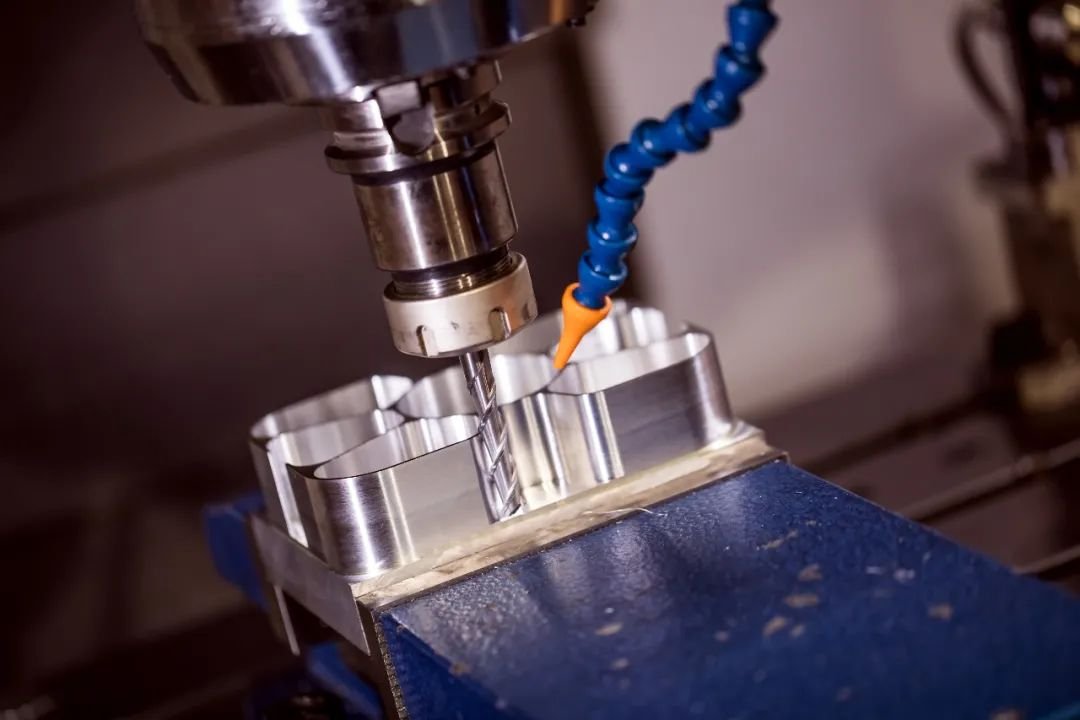
These cases reflect common industry scenarios. Your specific part geometry will determine exact time and cost savings, but the principle holds: complex geometries become simple with proper 5-axis programming.
04How to Select a 5-Axis CNC Machining Service (Actionable Checklist)
When evaluating providers, request documented evidence for these six criteria:
1. Machine capability list – Brand and model of 5-axis machines (e.g., DMG MORI, Matsuura, Hermle, Okuma). Ask for last calibration certificate per ISO 230-2.
2. Programming competency – CAM software used (Hypermill, NX, Mastercam 5-axis module). Request a sample toolpath simulation file.
3. Material expertise – Confirmed experience with your specific alloy/plastic. Ask for case studies of identical material.
4. Quality system – ISO 9001:2015 certification is minimum; for aerospace AS9100D; for medical ISO 13485. Request recent audit results.
5. Inspection equipment – CMM with 5-axis scanning capability (Zeiss, Mitutoyo) and surface finish profilometer.
6. Lead time & communication – Standard turnaround for prototypes (typically 5-7 business days) and production (2-4 weeks). Ask for a 24-hour design-for-manufacturing (DFM) feedback commitment.
05Common Mistakes to Avoid When Ordering 5-Axis CNC Service
Assuming all 5-axis services are equal – 3+2 positional machines are cheaper but cannot cut undercuts. Verify simultaneous capability before sending complex parts.
Skipping DFM review – A good provider will identify issues like inaccessible fillet radii or missing tool clearance. Always request a DFM report before production.
Ignoring post-processing – 5-axis leaves sharp edges at axis transition points. Specify deburring, tumbling, or thermal stress relief in your purchase order.
Using outdated CAD formats – Supply STEP (AP242) with embedded PMI (Product Manufacturing Information) for best results. Avoid STL or IGES.
06Cost Structure of 5-Axis CNC Machining Service (Transparent Breakdown)
For a typical prototype (one piece, 100x100x50mm, aluminum), total cost ranges $800 – $1,500. For production quantities (100+ pieces), per-part cost drops by 40-60% due to amortized programming.
07Actionable Recommendations to Maximize Value
If you are a product engineer:
Perform a 5-axis DFM analysis before finalizing design. Moving three separate 3-axis features into one 5-axis feature reduces cost dramatically.
Request a “process capability study” (PPK > 1.33) for critical tolerances.
If you are a purchasing manager:
Send the same CAD model to three 5-axis service providers. Compare their DFM feedback and quoted cycle times — large discrepancies indicate lack of real experience.
Ask for a “first article inspection report” (FAIR) per AS9102 standard, even for non-aerospace parts. This forces rigorous quality.
If you are a startup or hobbyist:
Many 5-axis services offer “economy 5-axis” using 3+2 mode for simpler angled features. Specify that you accept longer cycle times in exchange for lower rates (as low as $80/hour).
08Core Conclusion (Repeated for Clarity)
5-axis CNC machining service is the definitive solution for complex, high-precision parts that cannot be economically produced with 3-axis or 4-axis machines. The core advantages — single-setup accuracy, reduced cycle times, superior surface finish, and undercut accessibility — translate directly into lower total cost and faster time-to-market for industries from aerospace to medical.
Final action steps:
1. Identify the three most geometrically complex features on your part.
2. Search for “5-axis CNC service near me” or use online RFQ platforms (e.g., Xometry, Protolabs, but note: no brand names are mentioned here — choose any ISO-certified provider).
3. Provide a STEP file plus a 2D drawing with critical tolerances.
4. Request a DFM report and a sample part photograph from a similar project.
By following this guide, you will select a competent 5-axis partner and avoid the 80% of quality issues that arise from inadequate setup or programming. For parts that demand five-axis, there is no substitute.