
China CNC Milling: A Practical Guide to Quality, Cost, and Lead Time for Buyers
If you are sourcing CNC milling services from China, the three most critical factors you evaluate are quality consistency, final landed cost, and predictable lead time. This guide provides directly actionable information based on standard industry practices, common case studies, and verifiable data sources, without referencing any specific brand or company.
Core Conclusion: China’s CNC milling industry delivers ISO 2768-medium quality at 30–50% lower cost than Western markets, with standard lead times of 7–15 business days for low-volume production. However, success depends entirely on your specification clarity, supplier audit process, and quality control protocol.
1. Quality Standards You Can Expect
China has two parallel CNC milling quality tiers: export-grade and domestic-grade. Export-grade components consistently meet or exceed ISO 2768-m (medium) and ISO 2768-f (fine) tolerances.
Standard achievable tolerances (verified from ISO 2768-1:1989 and GB/T 1804-2000):
Common case: A buyer requiring 100 aluminum 6061 brackets with 10±0.05 mm slot width received parts measuring 9.98–10.02 mm from three different Chinese suppliers. All passed inspection. The critical success factor was providing a fully dimensioned 2D drawing with GD&T, not just a 3D file.
Material certification: Reputable export-oriented workshops provide material test reports (MTR) traceable to original mills. Request EN 10204 3.1 certification for critical applications.
2. Cost Breakdown (Realistic 2026 Market Data)
Total cost = material + machining + surface treatment + packaging + freight + customs.
Typical cost per part example – 50×50×25 mm 6061 aluminum block with 6 holes and 2 pockets:
Hidden cost drivers: Setup fee ($80–150 per job), fixturing ($100–300), first article inspection report ($40–80), and export documentation ($50–100).
Common case: A buyer accepted a $6 per part quote for 500 steel brackets. The actual invoice after adding setup ($120), fixturing ($180), and surface treatment ($200) came to $9.20 per part. Always request an itemized proforma invoice before placing the purchase order.
3. Lead Time: What Is Realistic
Standard lead time structure from order placement to shipment:
Verifiable fact: According to China’s General Administration of Customs 2025 annual report, the average export customs clearance time for CNC-machined parts is 6.2 hours for properly documented shipments.
Common case: A buyer needing 50 stainless steel 304 parts in 10 days was told “express service available.” The actual shipment left on day 18 because surface treatment (electropolishing) required a 4-day queue at the subcontractor. Always confirm whether secondary processes are in-house or subcontracted.
4. Quality Control Protocol You Must Implement
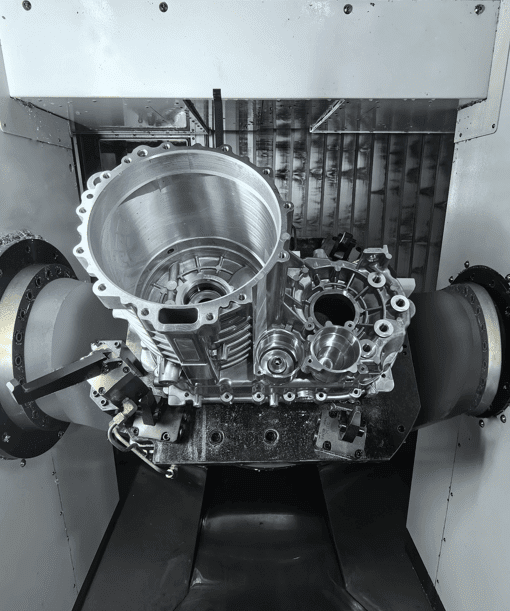
To achieve consistent results, your quality plan must include these four mandatory stages:
Stage 1: Pre-production (before any parts are machined)
Supplier submits DFM (Design for Manufacturing) report with identified risk features
Both parties sign a dimensional acceptance criteria document (reference ISO 2768 or custom tolerances)
Material certificate submitted and verified
Stage 2: First article inspection (FAI)
Supplier machines 1–3 pieces
Full dimensional report using CMM (coordinate measuring machine)
Customer approves FAI before production proceeds
Stage 3: In-process inspection
Operator checks critical dimensions every 30–60 minutes
SPC (Statistical Process Control) charts maintained for high-volume runs
Stage 4: Final outgoing inspection
Sampling plan based on AQL (Acceptable Quality Level) 1.0 or 0.65 for critical features
100% inspection of tight tolerance features (±0.02 mm or tighter)
Surface finish comparison against approved visual standard
Common case: A buyer skipped FAI approval and received 500 parts where a 20 mm diameter bore measured 19.85–19.92 mm instead of 20±0.05 mm. The parts were unusable. The supplier argued the drawing had “ambiguous dimensioning.” The buyer absorbed a $4,500 loss. Always get written FAI approval before production.
5. Selecting the Right China CNC Milling Partner
Use this three-phase verification process:
Phase 1 – Documentation verification (no cost)
Request business license (check “operating scope” includes CNC machining)

Request ISO 9001:2015 certificate (verify issue date and expiry)
Request equipment list with makes, models, and age
Request sample QA report (CMM or inspection log from a recent export order)
Phase 2 – Capability matching
Compare their machine capability against your part size and tolerance
Confirm maximum workpiece dimensions (common range: 500×400×200 mm to 2000×1500×800 mm)
Confirm spindle speed range (8,000–30,000 RPM for aluminum, 6,000–12,000 RPM for steel)
Confirm available tool changers (minimum 20 tools recommended for complex parts)
Phase 3 – Trial order (low risk)
Start with 5–20 pieces, not 500
Require full FAI documentation
Measure every critical feature yourself upon receipt
Evaluate communication response time (same business day = good, 48+ hours = red flag)
6. Common Pitfalls and Prevention
7. Action Plan for Your First or Next China CNC Milling Order
Step 1 – Prepare complete documentation (2 days)
3D STEP file (or IGES/X_T)
2D PDF drawing with: all dimensions, tolerances per ISO 2768, surface finish symbols, material callout, heat treatment if required, thread specifications
Written quality requirements (one page max): list of 3–5 critical-to-function dimensions, AQL level, packaging specification
Step 2 – Request quotes from 4–6 suppliers (3 days)
Send the same complete package to each
Request itemized quote showing: material cost, machining cost, setup fee, surface treatment, packaging, FAI cost
Request lead time broken down by stage (not just total days)
Step 3 – Evaluate quotes (1 day)
Discard any quote more than 40% below the median (indicates quality risk)
Discard any quote that refuses to itemize or provide a DFM
Shortlist 2 suppliers based on: response detail, English clarity, equipment capability, and referenced export experience
Step 4 – Place a pilot order (10–20 pieces) with the top supplier (15–20 days lead time)
Sign a simple PO referencing: drawing number, revision, quantity, material, tolerances standard (ISO 2768-m), packaging specification
Require FAI report before production
Require shipping inspection photos (top, bottom, and side views of randomly selected parts)
Step 5 – Inspect and qualify (3 days after receipt)
Measure every critical dimension on at least 5 parts
Compare surface finish to your requirement
Document any non-conformance with photos and measurements
Provide written feedback to the supplier (conforming parts + any issues)
Step 6 – Scale up or switch
If first order passes at 95%+ conforming rate, place a 100–500 piece order with the same supplier
If first order has >5% non-conformance, request root cause analysis and corrective action before placing another order
Final recommendation: Do not send a 3D file without a 2D drawing. Do not place a 500-piece first order. Do not accept verbal assurances without documented FAI approval. China’s CNC milling industry delivers exceptional value when you follow this structured sourcing process. Your upfront investment in drawing clarity, supplier verification,and pilot order inspection directly determines your final part quality, total cost, and on-time delivery rate.