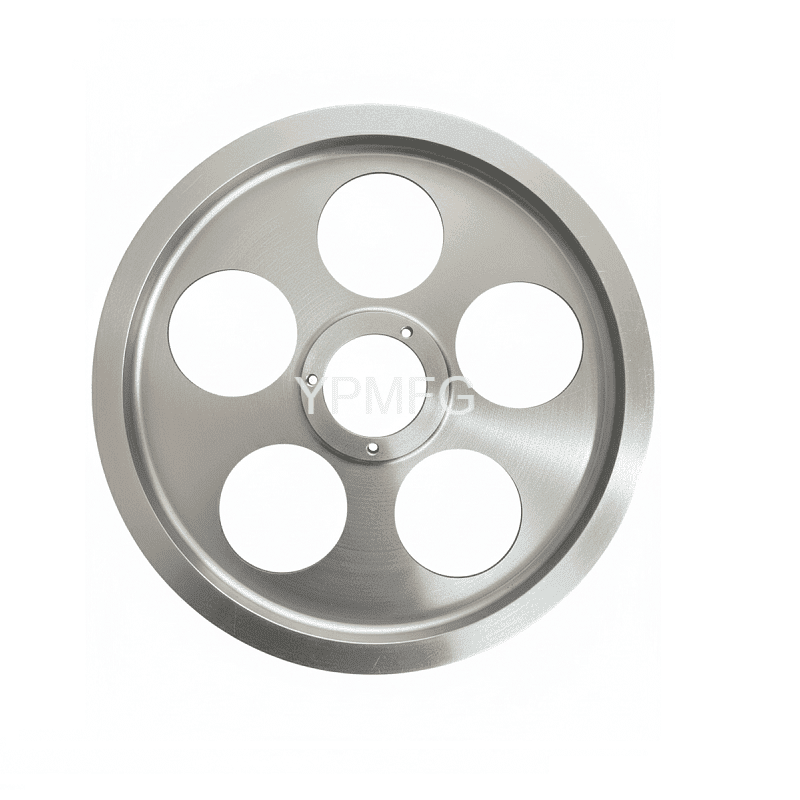
CNC turning services are commonly used to produce shafts, bushings, threaded parts, sleeves, and other cylindrical components. To get consistent results, do not focus only on unit price. You also need to check material selection, tolerance requirements, surface roughness, order quantity, and the supplier’s inspection capability. Many turned-part problems happen because critical dimensions, thread standards, or concentricity requirements are not clearly marked on the drawing.
If you are choosing CNC turning services, first confirm whether the supplier has suitable lathe capacity, experience with your material, and the ability to provide first-article and batch inspection reports. At YPMFG, turned-part projects are usually reviewed for drawings, materials, tolerances, and machining risks before quoting. This guide explains the key factors that affect CNC turning quality, cost, and lead time, helping you choose a machining partner with more confidence.
01What Determines Quality in CNC Turning?
Three factors directly control part quality: machine capability, tooling selection, and process verification.
Machine capability
Live tooling vs. standard lathe: Live tooling allows milling, drilling, and tapping in one setup, reducing positional errors.
Spindle accuracy: A well-maintained CNC lathe holds tolerances within ±0.0005 inch (±0.0127 mm). Always ask for the machine’s latest calibration certificate.
Tooling selection
Insert geometry and coating (e.g., CBN, PCD, or ceramic) must match the workpiece material.
Common mistake: Using general-purpose inserts for stainless steel or Inconel leads to poor surface finish and short tool life.
Process verification
First-article inspection (FAI) reports with dimensional data.
In-process sampling frequency: Every 20–50 parts for high-volume runs; 100% inspection for critical features.
> Real case: A medical device company ordered 500 titanium bone screws. The first supplier skipped in-process checks and delivered 18% out-of-tolerance parts. The second supplier provided full inspection logs at each 50‑part interval,achieving 100% acceptance.
02Materials and Their Machining Demands
Different materials require different cutting speeds, feeds, and coolants. The table below summarizes common turning materials and key parameters.
Key requirement: Always request material certificates (EN 10204 3.1 or equivalent) that trace back to the mill lot. Without a certificate, you cannot verify composition or mechanical properties.
03Tolerances and Surface Finish: What Is Realistic?

Do not specify tighter tolerances than your design needs. Unnecessarily tight tolerances increase cost by 50–200% without functional benefit.
General turning: ±0.005 inch (±0.13 mm) – suitable for clearance fits and non‑critical diameters.
Precision turning: ±0.001 inch (±0.025 mm) – for bearing seats and locating diameters.
High‑precision turning: ±0.0002 inch (±0.005 mm) – requires specialized lathes, temperature control, and multiple finishing passes.
Surface finish (Ra values, measured in microinches):
As‑turned (rough): 125–250 μin (3.2–6.3 μm)
Finish turning: 63–125 μin (1.6–3.2 μm)
Polished or ground: ≤32 μin (0.8 μm) – often requires secondary operations.
> Real case: An automotive parts buyer specified ±0.0002” on a motor shaft shoulder where ±0.001” was sufficient. Quoted price tripled. After revising the drawing, the same supplier delivered at 60% lower cost with identical assembly performance.
04Lead Times and Quantity Breaks
Understand how quantity affects production time.
Expedite fees: Requesting 24‑hour turnaround for 50+ pieces typically adds 30–50% to the part price. Plan for standard lead times unless you have a validated emergency need.
05Hidden Costs in CNC Turning Quotes
Many buyers focus only on unit price. Four additional line items often double the final invoice:
1. Setup and programming fee – Charged per unique part number. Typical range: $75–$250.
2. Material certification – EN 10204 3.1 adds $30–$80 per material lot.
3. First‑article inspection report – Detailed CMM or hard‑gauge data: $100–$300.
4. Shipping and export documentation – For international orders, add $50–$200 plus customs brokerage.

Action point: Request a line‑item quote that separates these costs. Compare apples to apples across suppliers.
06Quality Management Systems to Look For
Certifications do not guarantee quality, but they reduce risk. Prioritize suppliers with:
ISO 9001:2015 – Minimum for any production turning.
AS9100D – Required for aerospace and defense.
IATF 16949 – For automotive powertrain components.
ISO 13485 – For medical implants and instruments.
Even with certification, ask for CPk values for critical dimensions. A CPk ≥ 1.33 indicates a capable process.
07Practical Steps to Get Reliable CNC Turning Services
Follow this five‑step workflow to avoid common failures:
Step 1 – Finalize your technical drawing
Include all tolerances, surface finish callouts, and material grade.
Add notes for deburring, edge break, and thread class (e.g., 2B for UNC).
Step 2 – Request quotes from three suppliers
Provide the same drawing and quantity.
Ask each for: unit price, setup fee, lead time, and inspection deliverables.
Step 3 – Review sample parts (or FAI report)
For first orders, request 2–5 sample pieces. Measure at least three critical dimensions yourself.
Step 4 – Confirm material traceability
Do not release full payment without the material certificate matching your PO.
Step 5 – Establish a receiving inspection plan
For low volume: check 100% of key diameters.
For high volume: use AQL (e.g., ANSI/ASQ Z1.4, inspection level II).
> Real case: A pump manufacturer skipped step 4. The supplier substituted 12L14 steel for specified 4140. After 200 hours of operation, shafts fractured. A simple certificate check would have caught the substitution before assembly.
08Summary of Core Takeaways
Quality is not optional – define tolerances realistically and verify with FAI reports.
Material certificates are mandatory for any safety‑critical or wear‑resistant part.
Hidden costs dominate – get a complete line‑item quote.
Lead times vary with quantity – plan production schedules accordingly.
Always inspect samples – never assume a supplier’s capability based on price alone.
09Actionable Conclusion
To get better results from CNC turning services, start with four basics: prepare a clear and complete drawing, choose a supplier with the right industry certification, request a line-item quote, material certificate, and first-article inspection report, and check sample parts before full production.
Repeat this process for every new turned part number. It helps reveal unclear drawings, material issues, tight tolerance risks, or weak inspection control before they become costly problems. Start today by reviewing one existing turned-part drawing against this checklist. At YPMFG, turned-part projects are also checked for drawing details, material, inspection, and first-article requirements before production begins.