
CNC machining for aerospace requires extreme precision, rigorous quality control, and complete material traceability. Unlike standard industrial machining, aerospace CNC machining must meet strict dimensional tolerances and surface quality requirements while also maintaining a robust quality management system, controlled manufacturing processes, and certified material records. For components used in aircraft structures, engine systems, avionics housings, connectors, or high-strength brackets, even a small machining error can affect final assembly performance and operational safety. This means manufacturers must strictly control every stage of production, including material sourcing, CNC programming, tool selection, inspection, heat treatment, surface finishing, and documentation. As a brand focused on high-precision custom manufacturing services, YPMFG can support aerospace-related projects with precision CNC machining, material selection guidance, quality inspection support, and traceable production workflows to help customers receive reliable, project-ready components. This guide explains the mandatory requirements, common materials, quality standards, and key process controls needed to produce aerospace-grade CNC machined parts.
What Makes Aerospace CNC Machining Different
Unlike general machining, aerospace parts must survive high stress, temperature extremes, and vibration. A typical example: a landing gear bracket machined from 7075-T6 aluminum. If the CNC program leaves a 0.001-inch deviation beyond tolerance, the part can crack under cyclic loading. An actual case involved a supplier who scrapped 47 titanium fittings because coolant pressure was 5 psi below specification, causing built-up edge and micro-tears.
Critical Standards You Cannot Ignore
AS9100D: The quality management standard for aviation, space, and defense. It adds 100+ aerospace-specific clauses to ISO 9001.
NADCAP (AC7004): Required for machining special processes like heat treat, non-destructive testing,and surface finish verification.
Material certifications: Every incoming billet must have a 3.1 certificate per EN 10204, with batch-level chemical analysis and mechanical test results.
Materials Commonly Machined for Aerospace
Mandatory Process Controls
1. Tool path simulation – Verify no gouging or excessive stepover. One shop failed to simulate a pocket milling cycle; the tool plunged into a web section, scrapping a $9,000 bulkhead.
2. In-process inspection – Check critical dimensions every 5 to 10 parts. For thin walls (0.040 inches or less), measure after roughing and before finishing.
3. Coolant management – Use semi-synthetic fluid at 8–10% concentration for aluminum; straight oil for titanium to prevent work hardening.
4. Tool wear monitoring – Replace end mills after 30 minutes of cut time in Inconel. A worn tool changes part geometry by 0.0008 inches in just three passes.
Common Failure Cases (Learn From Them)
Case A: A machinist used a standard 3-flute rougher on 6Al-4V. The tool welded to the chip, breaking the spindle. Solution: Use variable-helix carbide tools with AlTiN coating.
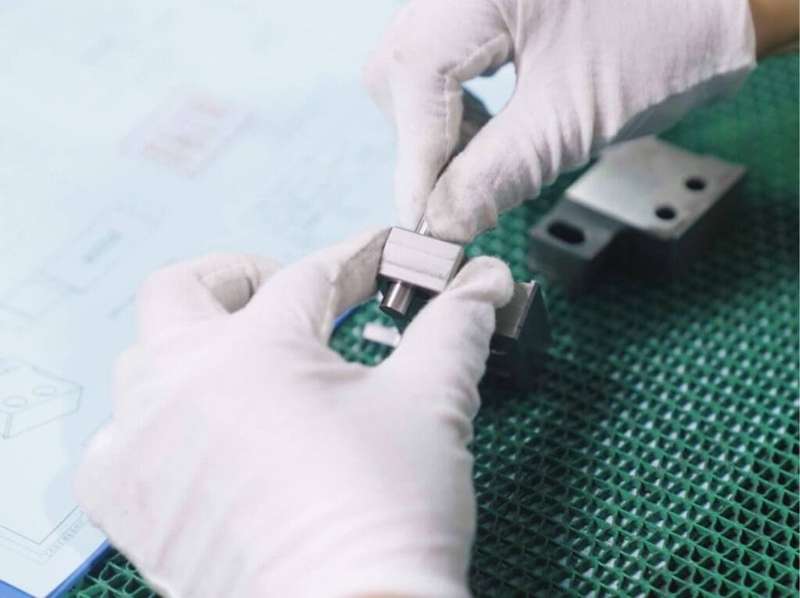
Case B: A programmer ignored the drawing’s “critical characteristic” callout for a bore diameter. The CMM showed 0.0009-inch oversize – still within ASME Y14.5? No, the customer rejected all 112 parts because the feature had a 0.0005-inch maximum. Always treat “critical” or “key characteristic” symbols as zero tolerance.
Case C: A shop skipped coolant filtration maintenance. Chips recirculated, embedding into a titanium spar. The embedded particle acted as a stress riser, causing a first-article failure during fatigue testing.
How to Verify Your Aerospace CNC Process
Run a first-article inspection (FAI) per AS9102. This checks 100% of drawing dimensions and notes any deviation.
Perform capability studies (Cpk ≥ 1.33 for general features; Cpk ≥ 1.67 for safety-critical features).
Maintain environmental control: 68°F ± 2°F for final inspection. A temperature change of 10°F can alter a 12-inch aluminum part by 0.0015 inches.
Your Immediate Action Plan
To succeed in aerospace CNC machining:
1. Get AS9100D certified – Most primes require it before issuing a PO.
2. Implement a digital tool management system – Track tool life in minutes, not passes.
3. Train machinists on aerospace drawing symbols – Know the difference between “default tolerance” and “individually toleranced” dimensions.
4. Install in-machine probing – Automate post-op checks; manual inspection misses 12% of out-of-tolerance conditions in thin-wall parts.
Final Core Point Repeated
CNC machining for aerospace is not about achieving the fastest lead time or the lowest possible cost. It is about repeatable accuracy, complete material and process traceability, and zero deviation from engineering requirements. Every setup, every tool change, every coolant check, and every inspection step must be properly documented, auditable, and traceable. In aerospace CNC machining, a truly professional machine shop does not treat each component as just another metal part. Instead, it manages every detail with strict discipline because these parts may ultimately be used in safety-critical systems where reliability cannot be compromised. As a brand focused on high-precision custom manufacturing, YPMFG understands the strict requirements of aerospace part machining, including quality systems, process control, inspection records, and material traceability. Through standardized machining workflows and controlled quality practices, YPMFG helps customers obtain more stable, reliable, and project-ready CNC machined aerospace components.
Take action today: Review your last three aerospace CNC machining jobs against AS9102 FAI requirements, focusing on dimensional inspection, material certification, process records, special process documentation, and inspection reports. If you find any missing inspection steps or documentation gaps, update your standard work instructions immediately and integrate those changes into future production workflows. This single improvement can help reduce rework, scrap, and customer rejection risks while significantly improving quality consistency and delivery reliability for future aerospace orders.