
Quick answer:
CNC machines are automated tools that use programmed instructions to cut, shape, and finish materials with extreme precision. Common examples include milling machines, lathes, routers, and plasma cutters, each suited for specific tasks from prototyping to mass production. The right CNC example for your project depends on the material, part complexity, and required production volume, making selection a critical first step.
Choosing the wrong machine can lock you into a cycle of compromised quality, unexpected downtime, and inefficient production. It’s not just about buying a machine; it’s about investing in a system that must work flawlessly within your specific workflow. The risk isn’t just a bad purchase—it’s a hidden drain on your entire operation that shows up in wasted material and missed deadlines.
Table of Contents
1. Milling Machines: The Workhorses of Precision
2. Turning Centers: Mastering Rotational Symmetry
3. Multi-Axis and Hybrid CNC Examples
4. How to Match the Machine to Your Material
5. Key Factors in Your CNC Selection Checklist
6. Common Questions About CNC Machine Types
Milling Machines: The Workhorses of Precision
CNC mills use rotating cutting tools to remove material from a stationary workpiece. They are arguably the most prevalent CNC machine type in job shops and manufacturing facilities. From simple 3-axis models for basic profiling to complex 5-axis machines for intricate aerospace components, their versatility is unmatched.
The core value of a milling machine lies in its ability to produce flat surfaces, slots, and complex 3D contours. A 3-axis machine moves the tool in the X, Y, and Z planes, sufficient for most prismatic parts. For more complex geometries, 5-axis machines simultaneously move the tool from multiple angles, drastically reducing setup time and improving accuracy on contoured surfaces.

A wrong choice here means either overspending on unnecessary capability or underpowering your shop, leading to bottlenecks. For instance, trying to run a high-volume aluminum job on an undersized spindle wastes time and risks tool breakage. YPMFG can help buyers compare spindle power, table size, and control systems against their specific part drawings to avoid this mismatch.
Turning Centers: Mastering Rotational Symmetry
CNC lathes, or turning centers, are designed for parts with rotational symmetry. The workpiece spins at high speed while a stationary cutting tool shapes it. This is the go-to process for creating shafts, bushings, and any cylindrical component. Modern CNC turning centers often include live tooling, which allows for milling operations on the same machine—a feature known as a CNC mill-turn machine.
The primary advantage is speed and concentricity for round parts. A CNC lathe can produce a finished diameter far faster and with better surface finish than a milling machine could. The integration of live tooling means features like off-center holes or flats can be machined in a single setup, eliminating errors from part repositioning and saving significant cycle time.
Ignoring the need for live tooling or a sub-spindle for back-facing operations forces secondary operations. This adds handling time, introduces potential alignment errors, and increases overall component cost. A clear understanding of your part’s complete feature set is essential before deciding between a basic lathe and a more advanced turn-mill center.
Multi-Axis and Hybrid CNC Examples
Beyond the standard 3-axis mill and 2-axis lathe lies a world of advanced machines. 5-axis machining centers, Swiss-style lathes, and multi-tasking machines combine operations to complete complex parts in one setup. These are the solutions for the most challenging geometries and tightest tolerances.
A 5-axis machine isn’t just a better 3-axis machine; it’s a different paradigm. It allows machining on five sides of a part in one clamping, which is critical for complex molds, impellers, and medical implants. Swiss-style lathes guide material through a guide bushing,providing extreme stability for long, slender parts like medical screws, which would deflect on a conventional lathe.
The risk is overcomplicating the process. These machines require sophisticated programming and skilled operators. Using a 5-axis machine for a simple bracket is an enormous waste of capital and technical resources. YPMFG supports projects that require this level of complexity, offering engineering evaluation to determine if a multi-axis approach is truly justified for your component’s design and volume.
How to Match the Machine to Your Material
The machine example is only half the equation; the material is the other. Aluminum, stainless steel, titanium, and plastics all demand different machine characteristics. A machine optimized for aluminum will struggle with hardened steel, and vice versa, affecting tool life, surface finish, and dimensional stability.
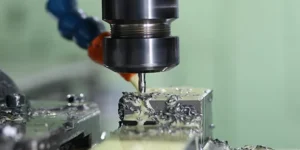
Key machine attributes change with the material. Machining aluminum efficiently often requires high spindle speeds (e.g., 10,000+ RPM) and rapid feed rates. Machining steel requires more torque at lower speeds, a more rigid machine structure to handle higher cutting forces, and often through-spindle coolant. For abrasive composites, you need specialized vacuum systems and spindle designs to protect critical components from dust.
Selecting a machine without this alignment leads to premature wear, poor part quality, and constant frustration. You can send your specifications to YPMFG for a review of material-specific requirements before finalizing your equipment decision.
Key Factors in Your CNC Selection Checklist
Your choice should be guided by a concrete list of requirements, not just machine specifications. Start with your part: its size, features, tolerances, and material. Then, translate that into machine needs like work envelope, axis count, spindle type, and tool changer capacity. Finally, consider the production environment: required output volume, available operator skill, and future job flexibility.
1. Part Geometry & Size: Determine the necessary travel (X, Y, Z) and, for turned parts, the swing over bed and maximum part length.
2. Tolerance & Finish Requirements: A machine’s positioning accuracy and repeatability must be several times better than your part tolerance.
3. Production Volume: High-volume runs justify faster pallet changers and more automation; low-volume/high-mix requires quick setup flexibility.
4. Available Expertise: Complex machines demand skilled programmers. Ensure your team’s capability matches the machine’s sophistication.
5. Total Cost of Operation: Look beyond the purchase price. Factor in tooling costs, energy consumption, maintenance schedules, and potential integration costs with existing systems.
This checklist moves the decision from an abstract comparison of brands to a practical evaluation of fit. The biggest mistake is buying for a single “dream part” without considering the 80% of other work that will run on the machine.
Common Questions About CNC Machine Types
What is the main difference between a 3-axis and a 5-axis CNC mill?
A 3-axis mill moves the cutting tool in three linear directions (left/right, forward/back, up/down). A 5-axis mill adds two rotational axes, allowing the tool to approach the workpiece from virtually any angle without repositioning it, which is essential for complex contours.
Can one CNC machine handle both milling and turning?
Yes. Machines known as mill-turn centers or multi-tasking machines combine the functions of a lathe and a mill. They are ideal for complex parts that have both rotational and prismatic features, as everything can be completed in a single setup.
How do I know if I need a Swiss-style lathe instead of a standard CNC lathe?
Consider a Swiss-style lathe if your parts are long, slender, and have a high length-to-diameter ratio (often > 8:1). The guiding bushing provides superior support right at the cutting point, preventing deflection and allowing for superior precision on small, intricate components.
Is a more expensive machine always better?
Not necessarily. A more expensive machine often offers higher precision, speed, or advanced features. If your parts don’t require those capabilities, you are paying for unused potential. The “better” machine is the one that most cost-effectively meets your specific quality and output targets.
What should I provide to a machine shop for an accurate quote?
Provide a complete 3D CAD model (e.g., STEP, IGES) and a 2D drawing with critical dimensions, tolerances, material specification, and surface finish requirements. Also, state your required quantity and any applicable industry standards.
Choosing the Right CNC Machine for Your Application
The journey from a list of CNC examples to the right machine on your shop floor requires connecting technical specifications to real-world production outcomes. It’s a decision that balances capability, cost, and long-term operational efficiency. A well-chosen machine becomes a reliable partner; a poorly chosen one becomes a constant constraint.
Need help selecting the right CNC solution? The engineers at YPMFG specialize in translating part requirements into practical machining strategies. For a no-obligation engineering assessment, send your part specifications or CAD files. We can review your needs, identify the critical machining processes, and provide clear guidance on the type of machine capability your project truly demands.