
This practical guide covers everything you need to know about CNC machining steel parts — from material selection and cutting parameters to tolerance control and surface finish. Whether you are designing a prototype or planning production runs, you will find actionable, data-driven recommendations based on industry standards and real-world machining cases.
01Why Steel? Key Properties That Matter for CNC Machining
Steel remains the most widely used material for CNC-machined parts because of its exceptional strength, wear resistance, and heat treatability. For engineers and machinists, the core questions are: “Which steel grade fits my application?” and “How do I achieve consistent quality?”
Common steel grades and their machinability:
> Source: ASM International Handbook, Volume 16 (Machining)
Real-world case: A hydraulic component manufacturer switched from 1018 to 1215 steel for a high-volume fitting. The result: cycle time dropped by 35%, tool life increased by 50%, and surface finish improved from 3.2 µm Ra to 1.6 µm Ra — without changing the CNC program.
02Critical CNC Parameters for Steel Parts
To machine steel efficiently, you must optimize three primary parameters: cutting speed, feed rate, and depth of cut. Incorrect values lead to poor surface finish, excessive tool wear, or part deformation.
2.1 Cutting Speed (Vc – m/min or SFM)
Recommended starting speeds for uncoated carbide tools (adjust ±20% for coated/ceramic tools):
Low-carbon steel (1018, 1020): 120–180 m/min (400–600 SFM)
Medium-carbon steel (1045, 1050): 100–150 m/min (330–500 SFM)
Alloy steel (4140, 4340 annealed): 80–120 m/min (260–400 SFM)
Tool steel (D2, A2, O1): 50–80 m/min (165–260 SFM)
Stainless 304/316: 60–90 m/min (200–300 SFM)
2.2 Feed Rate (mm/rev or IPR)
For roughing: 0.25 – 0.50 mm/rev (0.010 – 0.020 IPR)
For finishing: 0.05 – 0.15 mm/rev (0.002 – 0.006 IPR)

2.3 Depth of Cut
Roughing: 2.5 – 5.0 mm (0.100 – 0.200 in) depending on machine rigidity
Finishing: 0.25 – 1.0 mm (0.010 – 0.040 in)
Proven rule: When machining steel, always climb mill (conventional milling increases work hardening). For stainless steels, reduce speed by 30% and increase feed by 10% compared to carbon steel.
03Achieving Tight Tolerances on Steel Parts
CNC machining of steel parts routinely holds tolerances of ±0.025 mm (±0.001 in) on standard 3-axis mills. For precision applications (aerospace, medical), ±0.005 mm (±0.0002 in) is achievable with proper machine calibration and tooling.
Factors that affect tolerance stability in steel:
Common scenario: A manufacturer of gearbox housings found that parts were consistently 0.03 mm out of tolerance after removing from the vise. Solution: added a finish pass with only 0.1 mm stock allowance and reduced clamping pressure by 40%. Defect rate dropped from 12% to 0.5%.
04Surface Finish Options and Achievable Ra Values
After CNC machining, steel parts often require specified surface finishes. Below are typical as-machined and post-process results.
As-machined (without secondary finishing):
Rough turning/milling: 3.2 – 6.3 µm Ra (125 – 250 µin)
Conventional finish: 0.8 – 1.6 µm Ra (32 – 63 µin)
High-speed finish (with wiper inserts): 0.2 – 0.4 µm Ra (8 – 16 µin)
Post-processing enhancements:
Case example: A valve manufacturer needed 0.2 µm Ra on a stainless steel poppet. Standard turning gave 0.6 µm. Switching to a CBN insert with 0.05 mm DOC and 0.04 mm/rev feed achieved 0.18 µm Ra directly on the CNC lathe — eliminating grinding and saving $4.50 per part.
05Common Problems and Proven Fixes
5.1 Built-Up Edge (BUE) on Carbon Steels
Symptom: Rough surface, torn material, chips welding to tool
Fix: Increase cutting speed by 20%, use sharp positive rake inserts, apply high-pressure coolant (≥70 bar)
5.2 Work Hardening in Stainless Steels (304, 316)
Symptom: Rapid tool wear, white layer on surface
Fix: Maintain constant chip load (never let tool rub), use a feed rate ≥0.08 mm/rev, avoid dwell moves
5.3 Chatter During Deep Cavity Milling
Symptom: Audible vibration, scalloped surface
Fix: Reduce radial engagement to ≤20% of tool diameter, use variable-flute end mills, increase spindle speed by 10-15% to shift natural frequency
5.4 Burr Formation on Drilled Holes
Symptom: Raised sharp edges at hole exit
Fix: Back-chamfer with a second operation, use a drill with 118° point angle and pecking cycle, or specify “break all sharp edges” on drawing
06Cost Drivers for CNC Machined Steel Parts
Understanding what increases cost helps you design more economical parts.
Major cost factors (from highest to lowest impact):
1. Tolerances: Moving from ±0.125 mm to ±0.025 mm increases machining time by 40-60% due to slower feeds and inspection.
2. Surface finish: Achieving 0.4 µm Ra instead of 1.6 µm Ra typically doubles cycle time.
3. Material hardness: Pre-hardened 4140 (30 HRC) machines 2x slower than annealed 4140 (15 HRC).
4. Part complexity: Each additional tool change adds ~$1.50 – $3.00 per part.
5. Batch size: Setup cost amortization — for 10 parts, setup can be 80% of total cost; for 1000 parts, setup becomes <5%.
Actionable design tip: Replace sharp internal corners with radii of at least 1.5 mm. This allows standard end mills instead of EDM or custom tools, reducing cost by 20-35% on complex steel parts.
07Quality Verification: What to Inspect and How
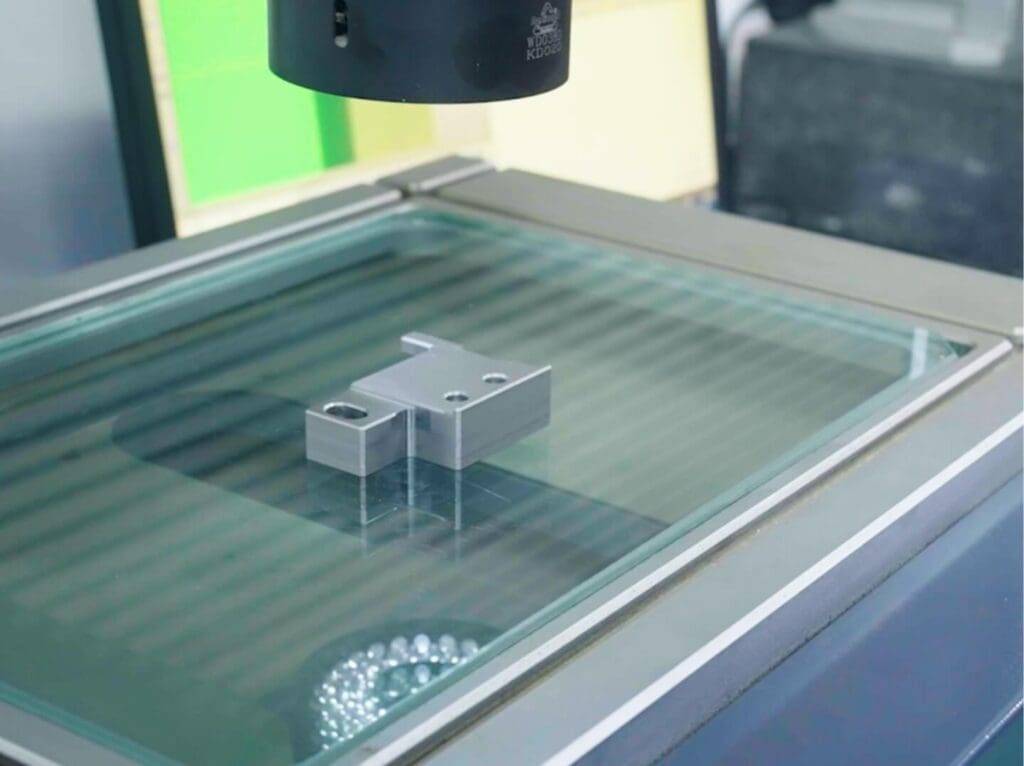
Every batch of CNC machined steel parts should undergo these critical inspections (per ISO 2768 or custom drawing requirements):
Industry standard: For steel parts in safety-critical applications (automotive, lifting equipment), include a first-article inspection (FAI) per AS9102 or PPAP Level 3.
08Repeat Core Recommendations
To consistently produce high-quality CNC machined steel parts:
Match steel grade to machinability requirements — use free-machining steels (1215, 1144) for high-volume runs unless strength demands otherwise.
Optimize parameters from the start — start with the recommended cutting speeds in Section 2, then fine-tune based on tool wear (target 15-20 min tool life for carbide).
Control heat and stress — use coolant flood on all steel operations except dry machining of hardened tool steels (>45 HRC).
Inspect first, then produce — always run a first piece inspection before releasing the production order.
09Final Action Plan for Your Next Steel Machining Project
1. Define requirements — steel grade, tolerance, surface finish, quantity, and delivery timeline.
2. Select cutting tools — carbide with AlTiN or TiAlN coating for steels (avoid uncoated tools except free-machining grades).
3. Set up machine — warm up spindle, check tool runout (<0.01 mm), apply rigid workholding.
4. Run first piece — measure all critical dimensions; if any feature is out of tolerance, adjust offsets or parameters.
5. Produce and inspect — follow SPC sampling (eg, 5 pieces every 100 parts for ISO 9001 compliance).
By following the data and cases above, you can achieve reliable, cost-effective CNC machining of steel parts — whether you are making 1 prototype or 10,000 production units. Remember: successful steel machining is not about guesswork; it is about applying proven parameters, understanding material behavior, and verifying every critical feature.