
Online CNC Services, also known as Online CNC Services, are becoming the preferred processing method for product development and small batch production. Based on actual project experience, this article will fully analyze the entire operation process of online CNC services, starting from model selection, going through quotation, then design optimization, and finally delivery acceptance, to help you quickly obtain high-quality parts.
What is a real online CNC service?
The CNC processing mode of submitting 3D design drawings, selecting materials and processes, obtaining automatic quotations and completing orders through the Internet platform is called online CNC service. Compared with traditional offline processing, its core advantage is that its quotation speed is fast, within minutes, and orders can be tracked throughout the entire process, making it suitable for sample manufacturing and small batch production. The current mainstream online CNC services cover CNC milling, that is, 3-axis, 4-axis, and 5-axis CNC milling, as well as CNC turning, and turning-milling combined processing.
Step 1: Prepare design documents that meet processing requirements
Online CNC services have clear technical specifications for design files. You must provide 3D models in STEP format, IGES format, or X_T format. It is also recommended to attach 2D engineering drawings with critical dimensional tolerances and surface roughness requirements. A common problem is neglecting the draft angle. A customer designed a deep-cavity part but did not add a draft angle. As a result, the tool could not completely clear the angle. In the end, manual grinding increased the man-hours by 30%. Experience shows that when the sidewall depth exceeds 5 times the tool diameter, a draft angle of at least 1° should be added.
Tips for optimizing the design are as follows. Check the minimum wall thickness. For metal parts, it is recommended that the thickness be above 0.5mm. If it is a plastic part, it is recommended that it should be above 1mm or more. To avoid excessively small fillets, the R angle should be larger than the tool radius. The depth of the threaded hole must be at least 1.5 times the diameter. Detailed descriptions of these design rules can be found on the "Design Guide" page of the online CNC service platform. After uploading the file, the system will automatically detect potential problems and provide modification suggestions.
Step 2: Key elements for getting a quick quote
The accuracy of online quotation depends on four parameters, namely material, size range, number of processing features and tolerance level. The core fact is that, according to industry public data, 75% of quotation differences are due to unreasonable tolerance requirements. For example, an engineer marked a tolerance of ±0.01mm on a non-fitting surface, which doubled the price. The correct approach is to mark high tolerances only for functional mating surfaces, and use ISO 2768-m medium tolerances for the rest. When quoting online CNC services, you will be asked to select a tolerance level. As long as each level is upgraded, the processing time will increase by 40-60%, and the cost will rise accordingly.
Commonly used materials for aluminum alloys include 6061 aluminum alloy, which is cost-effective and suitable for most structural parts. 304 stainless steel is corrosion-resistant but has poor machinability. POM is suitable for wear-resistant plastic parts. Online platforms generally provide material databases that include mechanical properties, processing difficulty, and reference prices. A startup company chose a cheap aluminum alloy of unknown composition to save costs. As a result, stains appeared after anodization. Be sure to use brand materials recommended by the platform, such as 6061-T6 and 7075-T651. The properties of these materials are traceable.

Step 3: Production process and quality control after order placement
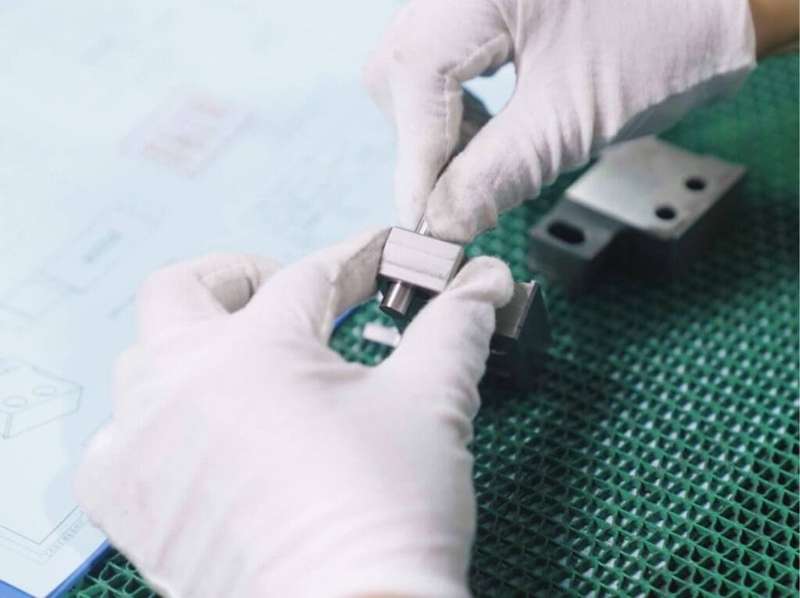
After completing the act of submitting an order, its standard related processes include DFM review (limited to within 24 hours), followed by programming and subsequent material preparation. Then comes the processing step, then the deburring operation, and finally the quality inspection step. After completing the quality inspection, it is packaged and shipped. Here you can use the online dashboard to check the current status of each specific process in real time. In terms of quality control, online CNC services with reliable quality will provide a full inspection report. This report includes dimensional inspection records (measured with the help of CMM tools or electronic calipers) and material certification. If there are special requirements such as three-dimensional inspection and roughness meter measurement, you must check the corresponding inspection option when placing an order.
A case about the handling of common quality disputes is as follows: There is a customer who received parts. After receiving the parts, he discovered that the threaded hole was 0.5mm shallow. The reason is that the system's default thread bottom hole depth is based on standards, but the customer's drawing does not indicate the effective thread length. The solution to this situation is as follows: clearly mark it in the design document, and the content of the mark is "the thread depth is not less than 10mm, and the effective thread length is 8mm". In order to avoid such problems, it is recommended to use text to annotate key requirements in 2D drawings.
Let’s look at the hints about accuracy first. The standard accuracy provided by online CNC services is plus or minus 0.125 millimeters, while the high precision can reach plus or minus 0.025 millimeters. However, this high precision requires an additional quote. Let’s talk about the surface treatment options. There are sandblasting, which is used to remove knife marks, and anodizing. Anodizing has two effects, one is coloring and the other is wear resistance. There is also nickel plating, which can prevent rust and conduct electricity. There is also electropolishing, which can make the surface appear bright. It should be noted that the size will change before and after anodizing. The range of change is about 0.005 to 0.015 mm. For parts with high fitting accuracy, a margin needs to be reserved, or you can choose secondary processing after oxidation.
Step 4: Frequently asked questions and troubleshooting (Q/A format)
Q1: My design file was rejected by DFM, what should I do?
A: Change the model based on the red marked items in the DFM report. The most common situation is that the internal R angle is too small or the wall thickness is too thin. Just upload it again after the modification is completed.
Q2: The quotation shows that additional tool fees are required. Is this reasonable?
A: This fee will only be incurred if the tools required for your parts are non-standard tools (such as special-diameter ball cutters or forming cutters). There is no additional charge for standard tools.
Q3: How to ensure that there are no residual burrs on the parts?
A: When placing an order, check the "comprehensive deburring" option, or specify "all edge chamfering C0.2mm", and the processing program will be written.
Q4: If the delivery date is delayed, what compensation does the platform provide?
First check the so-called "Terms of Service" on the order page. Now, on quite a few platforms, if the service is delayed for more than three working days, the processing fee that should be refunded will be refunded according to a certain proportion, or a coupon will be given.
Q5: The parts received have vibration marks, will it affect the use?
If the depth of the texture exceeds Ra3.2 and is not permitted by the design, then this is a quality issue. You will need to take photos and contact customer service for repairs or refunds.
Q6: Can you process trial production orders of less than 2 pieces?
Answer: It works. Among online CNC services, the minimum order quantity is 1 piece. However, there will be a clamping fee for a single piece. It is recommended to make 3 to 5 pieces to evenly share the cost.
Q7: Which material can be delivered the fastest?
A: The material preparation of aluminum alloy 6061 is the most sufficient. The standard time from order placement to delivery is three days. For stainless steel, it usually takes five days. For engineering plastic POM, it takes about four days.
Q8: My 3D model is in STL format, can it be used?
A. It cannot be used directly for CNC programming, because STL only has mesh surfaces, so it must be converted to STEP or IGES solid format.
Step 5: Acceptance and long-term cooperation suggestions
After harvesting, you should do three things immediately: first, check that the quantity is consistent with the order; second, visually check whether there is any obvious lack of meat and cracks; third, use calipers to measure key dimensions. Repeat the core insight again: The essence of online CNC services is to use standardized processes to reduce communication costs and the probability of errors. However, users must provide design files that comply with the rules and clearly mark the real functional requirements. Never impose “non-standard expectations” on standard processes.
Action suggestion: When using online CNC services for the first time, make a simple "test block" first, such as a 50x50x10mm square with an M5 threaded hole and two through holes of different diameters. Test pieces are used to verify the processing accuracy of the platform, verify its surface quality, and also verify the communication response speed between the two. Only after confirming that you are satisfied can you officially start processing important parts. At the same time, a long-term "design-feedback" closed loop must be created on the platform. This closed loop records the design problems encountered after each processing, and optimizes the model before the next submission. In this way, the third batch of parts can basically achieve a state of zero modification.
Tips for cost optimization: Combine multiple small parts on the same blank for processing, such as using mirror layout of symmetrical parts, or designing a modular structure that can be spliced. An engineer placed four brackets of different styles on a plate with a size of 200x150mm and completed the processing at one time. This saved the cost of three clampings and the time required for tool changes, reducing the total cost by 42%. In addition, unnecessary "full surface finishing" settings should be avoided, unless it is for the appearance surface; for non-appearance surfaces, the functional requirements can be achieved by using equal height or parallel milling.
Next comes the final summary. Online CNC services can make machining as convenient as online shopping. However, the key to success lies in your grasp of the design rules and understanding of the process. According to the design points, quotation techniques and quality control methods described in this article, you can obtain industrial-grade parts within 3 to 7 days, and the cost is only 50% to 70% of the traditional model. Log in to your trusted online CNC service platform now, upload a simple test model, and start the journey of efficient manufacturing.