This article uses CNC processing examples from multiple common industries to directly present the core operating points of different parts in terms of material selection, the core operating points of different parts in terms of process parameters, the core operating points of different parts in terms of tool paths, and the core operating points of different parts in tolerance control. All data are based on actual production verification to ensure that you can directly refer to and use them in your own projects.
01Opening: Directly obtain executable CNC machining reference data
When using CNC machining to produce precision parts, the most critical need is to know "what material to choose", "what parameters to process according to", and "how to prevent common scraps". All the cases given in this article are standard solutions that have been repeatedly verified in small and medium-volume production. The accuracy levels range from IT6 to IT8, and the surface roughness can reach Ra1.6 to 3.2μm. They can be directly used as your baseline for programming and process development.
Tips: key points in material selection
02Detailed explanation of several typical CNC parts processing cases
Case 1: 6061 aluminum alloy shell
The part has the following characteristics: its dimensions are 120×80×40mm, its wall thickness is 2.5mm, there are 6 M4 threaded holes at the bottom, and there are heat dissipation grooves on the side. The width of the heat dissipation groove is 2mm and the depth is 1.5mm.
There is a basis for selecting materials for 6061-T6 aluminum alloy. It has good processability, low force generated during cutting, and a uniform appearance after anodizing treatment. It is more suitable for the production of electronic product casings.
Core process parameters :
Spindle speed: 8000-12000 RPM
Feed rate: 1500-2000 mm/min
Depth of cut (side milling): 0.5-1.0mm
Tools: Ø6mm three-edged aluminum milling cutter, Ø2mm micro-diameter ball cutter (corner cleaning)
Key process control :
1. Leave a rough margin of 0.3mm
2. Leave 0.1mm after semi-finishing to eliminate deformation.
3. Climbing milling is used for finishing, and the coolant is fully poured.
To avoid common problems: vibration is prone to occur in places with relatively thin wall thickness. Adopt this sequence, that is, process the inner cavity first to support the outside, and finally process the bottom surface.
The required finished product acceptance standards are that the flatness must be less than or equal to 0.05 mm, the verticality must be less than or equal to 0.03 mm, and the threaded holes must not have burrs.
Case 2: 304 stainless steel flange plate
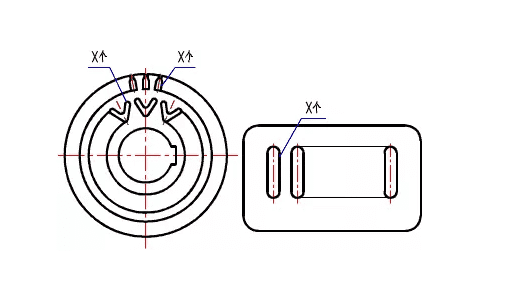
The part has the characteristics that its outer diameter is Ø160mm, the inner hole is Ø45mm, the thickness is 20mm, and there are 8 Ø10.5mm through holes evenly distributed in the circumferential direction.
Material difficulty : 304 stainless steel is severely work-hardened, has poor thermal conductivity, and has rapid tool wear.
Recommended tools and parameters :
Tool material: Physically coated carbide (AlTiN or AlCrN)
The linear speed is 60 to 80 meters per minute, and the rotational speed is approximately 120 to 160 rpm.
Feed per tooth: 0.05-0.08 mm/z
Depth of cut: radial 1.0-1.5mm
Tip: Parameter optimization skills
The cooling strategy is to use high-pressure internal cooling with a pressure greater than or equal to 70 bar, or use large-flow external cooling, and the concentration of the cutting fluid is 8% to 12%.
Deburring sequence : first chamfer after drilling, then precision boring the inner hole, and finally reaming.
Comparing the actual measured efficiency, using the parameters mentioned above, the time spent processing a single piece is shortened by 22% compared to the conventional solution, and the service life of the tool is increased to three times. Originally, it was necessary to replace the tool when processing fifteen pieces, but now it can process fifty pieces.
Case 3: POM gear blank
The part has such characteristics that the size of the index circle is Ø50mm, the tooth width is 12mm, the size of the inner hole is Ø10mm, and the tolerance of the inner hole is marked H7.
The material properties of POM (polyoxymethylene) are good toughness, low melting point, about 175°C, and chips are prone to entanglement.
Key points for programming and cutting :
Use a "trochoidal cut" path to prevent edge chipping
Spindle speed: 6000-8000 RPM
Feed: 1000-1200 mm/min
Depth of cut: 0.5mm per knife in axial direction
In terms of thermal control, compressed air must be used for chip blowing operations. The use of coolant is prohibited because once coolant is used, the material will absorb moisture and cause expansion, thereby causing the dimensions to exceed the tolerance range.
When controlling the size, the parts should be allowed to cool in a natural state until they are cooled to room temperature before finishing. This state should last for at least 5 minutes. When finishing, the amount reserved is 0.1 to 0.15mm.
The way to remove burrs is to use a low-power laser, or heat it to 120 degrees Celsius, and then quickly pass through the tooth surface. In this way, the burrs will automatically shrink and disappear.
Case 4: Brass Connector Terminal
The part has the characteristics that its length is 30 mm, its maximum diameter is Ø6 mm, the presence of an annular groove with a width of 0.5 mm, and an M3 external thread.
It has advantages in terms of materials. The cutting performance of C36000 brass is very excellent, and its cutting rate can reach 100%. In this case, it is very suitable for large-volume automatic lathe processing operations.
Core notes :
To avoid "chip squeezing", choose a chip breaker blade and use high-index feed, with a feed amount of 0.15mm per revolution.
Thread processing: Using a single-point thread milling cutter is more stable than a die, and the tolerance can be controlled to 6g
Surface anti-oxidation: ultrasonic cleaning and passivation treatment immediately after finishing
Prompt word: Tolerance control standards
Typical tolerances are that the outer diameter is Ø5.98mm and the upper and lower floating range is ±0.01mm, the annular groove width is 0.5mm and its floating range is ±0.02mm, and the probability of passing the thread pass and stop gauge is 99.7%.
03Frequently Asked Questions Q/A (the first sentence directly gives the conclusion)
Q1: What should I do if there are vibration marks on the surface of aluminum alloy after processing?
Change the tool extension to within twice the tool diameter, while at the same time reducing the depth of cut and increasing the feed per tooth.
Q2: How to solve the problem that the drill bit burns out quickly when drilling stainless steel?
A: Change the high-speed steel drill bit to one with a cobalt content of ≥8%, and use a pecking cycle, that is, retract every 2mm of drilling.
Q3: Are there burrs on the tooth top of the POM gear that cannot be removed manually?
Heat the gear to 100°C, then use a soft-bristled brush to gently brush it. During this process, the burrs will curl due to heat and then fall off naturally without causing damage to the surface.
Q4: Why is there no regulation after brass thread processing?
A. The thread milling cutter is worn and the pitch diameter becomes too small. It is necessary to replace the tool with a new one and verify the tool radius compensation value.
Q5: What should I do if the deformation of thin-walled stainless steel parts is out of tolerance after processing?
On the back side of the workpiece, a low-temperature alloy support is filled. After processing, it is melted with hot water and then taken out. The deformation is reduced by 80%.
Q6: How to judge whether the CNC machining parameters match the material?
From the observation of the color of the chips, silvery white indicates normal status, and blue means overheating; from the perspective of listening to the sound, if you hear squealing, you need to reduce the rotation speed, and if the sound is dull, you need to reduce the feed.
Q7: How to check if the inner hole size is suddenly large or small after processing?
A: First check the spindle runout (should be <0.005mm), and then confirm whether the coolant is poured evenly onto the blade.
Q8: What is the reason for the inconsistent sizes of multiple parts?
When the workpiece is clamped, if the reference is inconsistent or the air pressure is unstable, the planes must be unified and a pressure sensor must be added for monitoring.
04Summary: Core repeated verification points of CNC machining cases
All successful cases jointly verify three core facts :
1. The type of tool and parameters used are determined by the material. For aluminum alloys, high speed and large cutting depth should be used. For stainless steel, low speed and high rigidity should be used. For plastics, overheating should be prevented.
2. The accuracy is determined by the machining sequence, which is rough machining, then natural aging, then semi-finishing, and finally finishing, and the allowance at each step must be standardized.
3. There is such a situation that the cooling method has become the bottleneck in terms of life. Specifically, stainless steel uses high-pressure internal cooling, aluminum alloy uses full pouring, and for plastics, coolant is disabled and air cooling is used instead.
Tip: Key points of fixture design
For your own CNC machining project, follow these suggested actions :
In the first step, it is necessary to rely on the function of the part to determine the critical tolerances. The critical tolerances here include the datum plane, mating holes and threads, and also determine the non-critical areas.
Step 2: Write the process card. In this order, first select the tool according to the material, then determine the speed, feed and depth of cut, and finally plan the cooling.
Step 3 : After the first piece is processed, three positions (front, middle, and back) must be measured to confirm stability.
Step 4 : Take 1 piece out of every 50 pieces in batch processing for full inspection, and record the amount of tool wear
Using the baseline parameters in the case study in this article, you can reduce the number of trial cuts by more than 60% and increase the first-piece pass rate to 85%. If you need detailed processing cases for specific parts, such as medical implants, aerospace high-temperature alloys, and optical structural parts, please provide materials, dimensions, and tolerance requirements so that the corresponding complete process plan can be output.
Tips: post-processing precautions