When machining round or irregular workpieces on a CNC mill, a chuck is often the most practical workholding solution. This guide covers proper chuck selection, setup procedures, common mistakes, and safety practices—so you can achieve accurate, repeatable results without workpiece slippage or tool damage.
01Why Use a Chuck for CNC Milling?
Unlike a vise (best for square or rectangular parts), a chuck securely grips cylindrical, hexagonal, or oddly shaped stock. It also allows rapid centering and repositioning. Typical applications include:
Milling flats on round shafts
Drilling cross-holes in bushings
Machining eccentric features on turned parts
Case example: A job shop needed to mill a keyway on 50 round steel shafts (Ø25mm). Using a vise required shimming each part to align the keyway center, taking 4 minutes per piece. Switching to a 3‑jaw chuck with a stop reduced setup to 45 seconds per part and eliminated alignment errors.
02Types of Chucks for Milling Operations
> Recommendation: For general CNC milling of round stock,start with a 3‑jaw chuck (runout ≤0.05mm). For precision work or odd shapes, use a 4‑jaw independent chuck.
03Step‑by‑Step Setup for Chuck on a CNC Mill
Follow this sequence to mount and align a chuck safely:
Step 1 – Clean all mating surfaces
Remove chips, coolant residue, and burrs from the machine table, chuck mounting plate, and T‑nuts. Contamination causes angular misalignment.

Step 2 – Mount the chuck securely
Use at least four M12 or larger T‑slot bolts (grade 12.9). Tighten in a star pattern to 70‑80% of the bolt’s rated torque. Do not over‑tighten – it can distort the chuck body.
Step 3 – Dial in the chuck
Mount a precision test bar (or a ground rod) in the chuck jaws. Sweep with a dial indicator:
Radial runout at 25mm from jaws: ≤0.03mm
Face runout (axial): ≤0.02mm over 50mm diameter
If runout exceeds these values, tap the chuck gently with a soft mallet while loosening two opposite bolts, then re‑tighten.
Step 4 – Set workholding pressure
For manual chucks, tighten jaws using the chuck key – but never use a cheater bar (pipe extension). For power chucks, set pressure according to material:
Aluminum/brass: 8‑12 bar (115‑175 psi)
Steel/stainless: 15‑20 bar (215‑290 psi)
Step 5 – Verify part security
Perform a manual push test (try to rotate the workpiece by hand). Then run a low‑RPM air cut (500 RPM, no load) to listen for chatter or vibration.
04Common Mistakes and How to Avoid Them
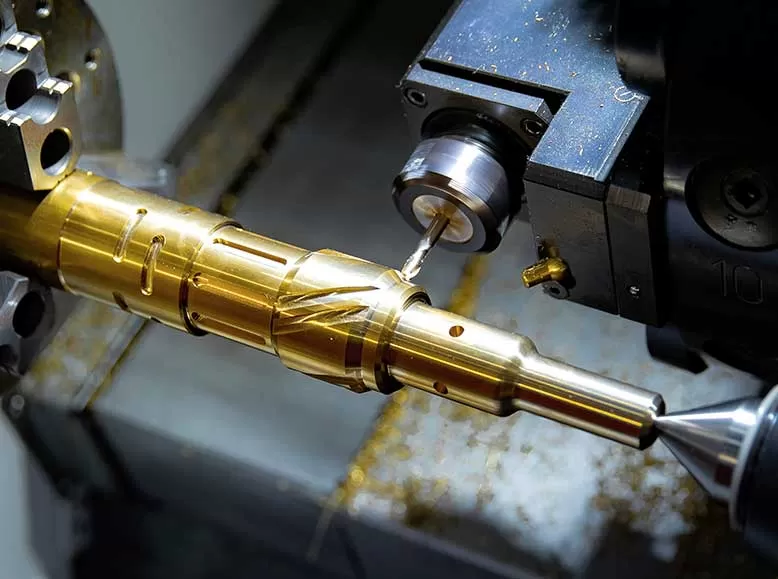
Real‑world incident: An operator milled a stainless steel bushing with only 10mm of jaw engagement (jaw depth was 40mm). The bushing pulled out during a 6mm endmill cut, destroying the tool and scrapping the part. The rule: minimum grip length = 1.5× jaw height (e.g., 30mm grip for 20mm jaws).
05Safety Checklist Before Every Chuck‑Milling Job
[ ] Chuck key removed (never leave key in chuck – even for “just a second”)
[ ] Workpiece cannot rotate inside jaws (use a stop or shoulder)
[ ] Cutting forces directed toward the machine table (avoid climb milling on interrupted cuts)
[ ] Coolant directed away from chuck openings (prevents jaw corrosion)
[ ] No loose clothing or gloves near rotating chuck
> Critical warning: A chuck used on a CNC mill must never be operated above its rated maximum RPM. Most manual chucks are rated ≤3000 RPM. Exceeding this can cause jaw failure and high‑energy projectile ejection.
06Maintenance for Consistent Accuracy
Weekly: Clean jaw guides and lubricate with light spindle oil.
Monthly: Check chuck runout with a test bar. If runout exceeds 0.08mm, disassemble, clean, and regrind jaws.
Every 500 operating hours: Inspect jaw teeth for deformation. Replace if any tooth is flattened or cracked.
07When NOT to Use a Chuck on a CNC Mill
Avoid chucks in these situations:
Very thin‑walled parts (use expanding mandrel)
Non‑round with large flat surfaces (use vise or fixture plate)
High‑torque roughing (use collet or hydraulic holder)
Parts requiring indexing to multiple faces (use indexer with chuck)
08Core Takeaway
A chuck is an efficient workholding solution for round and irregular parts on a CNC mill – but only if you select the right type, verify runout, respect grip length rules, and never exceed speed ratings.
09Actionable Recommendations
1. Before your next circular part job – Measure the stock diameter and required grip length. If both fit your chuck’s range, use the 3‑jaw self‑centering chuck.
2. Create a setup card – Write down torque values, dial indicator targets, and RPM limits for each chuck model in your shop.
3. Train all operators on the “1.5× jaw depth” rule and the absolute prohibition of leaving the chuck key in place.
4. Inspect your chuck today – If runout exceeds 0.1mm, schedule a jaw grinding or replacement.
By following this guide, you will achieve secure, accurate chuck milling with fewer crashes and better surface finishes.